The Sonar AI Prompt Library crossed 400 prompts today. Thirty-seven of them are new, one was rebuilt from the ground up, and four of the new ones are free.
If you're not familiar with the library, here's the short version. Sonar AI is an AI agent that runs inside NetSuite. Every prompt in the library is a playbook that I engineered and tested against live NetSuite data, and you run it inside your own account, against your own records. Nothing is exported, and nothing gets pasted into a chatbot that has never seen your account. You run the prompt, and a few minutes later you have a report that you could put in front of a board, a lender, or an auditor.
This release is a little different from the two in August. Those were broad. This one is deep. Most of these prompts were built one at a time over the past month, each of them run against a test account until the output held up, and many of them were previewed on LinkedIn as they were finished. Here's the full set. Every prompt links to a sample report, produced by running it against a NetSuite test account.
Four New Free Prompts
The free tier is now 34 prompts. I picked these four because each one is a first run: something you can point at an account you've never seen and learn from in ten minutes.
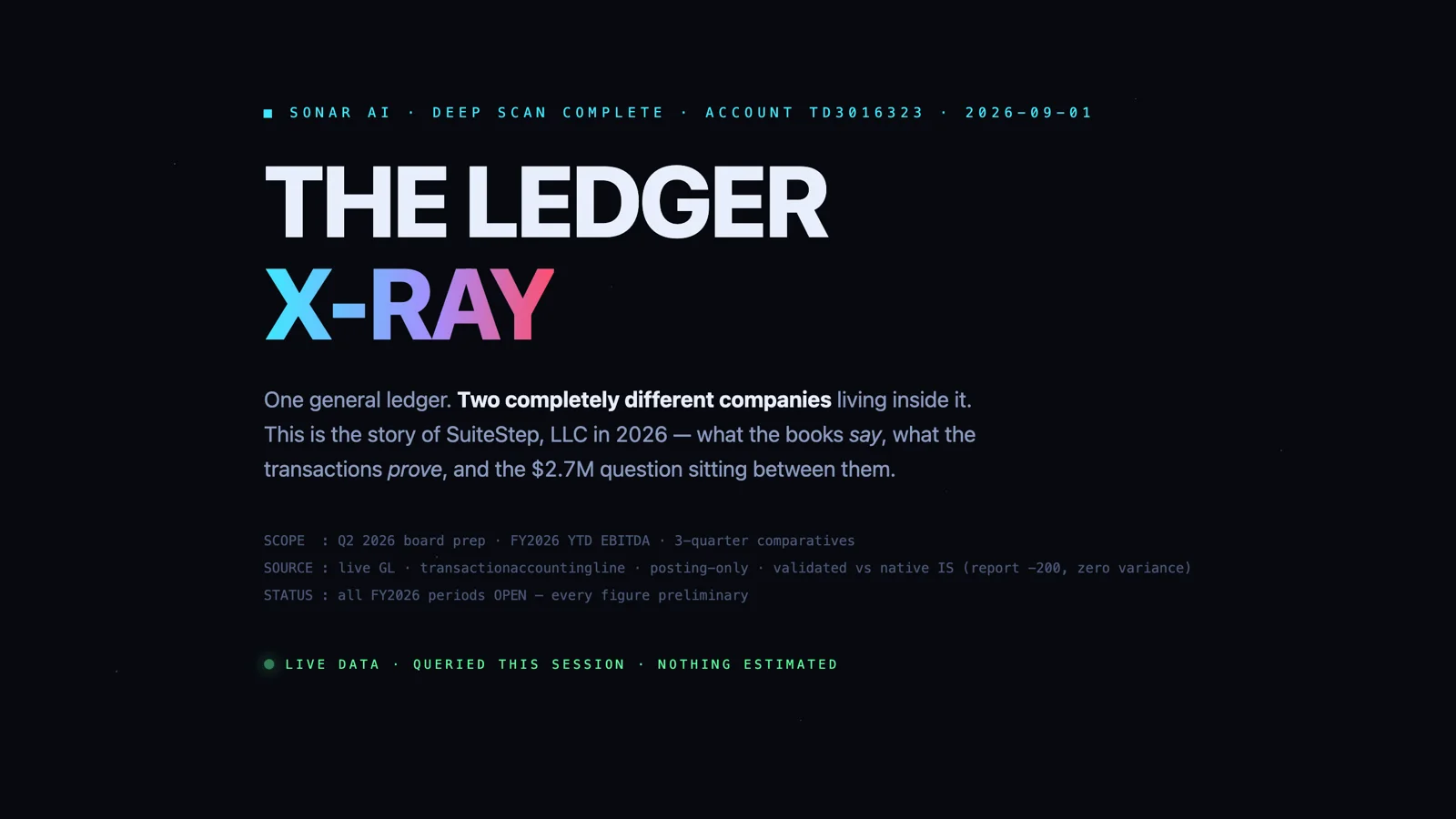
- The Ledger X-Ray - a financial documentary in five acts, built from your general ledger. It opens with the surface reading that everyone believes, then splits revenue by how it entered the ledger, ties the control accounts to their subledgers, and computes the contested ratios every defensible way before labeling which ones you can present and which ones you can't. On the test account, 81% of revenue had been posted by anonymous monthly journals, and a genuinely healthy transactional business was accelerating underneath them.
- Instance Integrity Diagnostic - answers the question that comes before every other report: can you trust the numbers this instance is producing? It sweeps revenue integrity, receivables discipline, dimensional coverage, and data governance, and it numbers every finding with a severity. Its signature test decomposes GL income by transaction type to find revenue with no document behind it. It caught an account where 87% of reported revenue was journal-posted with no customer, item, or document.
- Customer Revenue Concentration - how dependent are you on your largest customers, and is that rising or falling? HHI, effective customer count, the Lorenz curve, and the number of customers it takes to reach 50% and 80% of revenue, all of it for this year and last on a like-for-like window. It names the customers who moved the numbers, and it flags the one-invoice whales that may not come back.
- Cash Application Process Mining - the shortest of the new process-mining prompts and the on-ramp to the rest. It follows every customer payment to the invoice it was applied to, measures touches to settle, finds the unapplied balances and says why each one is unapplied, and catches cash that bypassed Undeposited Funds. In the test account, 85% of open receivables turned out to be test invoices created in a single sitting. The one real overdue was a $53K invoice, 63 days late. That's the collection call. Everything else was noise.
If you're new to Sonar AI, the free tier is where I suggest starting. There's nothing to buy.
Process Mining for Every Major Flow
Process mining rebuilds a business process from the transactions it left behind, as it was actually executed rather than as it was designed. NetSuite keeps the links between documents in a table, and that table turns out to be enough to reconstruct the whole flow.
Seven prompts in this release do that, one per flow, and they share a method: the same audit-grade report format, every SuiteQL query printed verbatim in an appendix, a worked hand-check at the end, and nothing written to the account.
- Order-to-Cash Object-Centric Process Mining - the anchor. Sales order to fulfillment to invoice to payment, as an event log with variants, waiting times, and a full exception register. It found a cluster of orders being billed and paid a month before they shipped.
- Procure-to-Pay Object-Centric Process Mining - the same method for purchase order to receipt to bill to payment, with a line-level three-way match. On the test account, 99% of bills were paid early, a median of 28 days before due, and 44% of bill value never touched a purchase order.
- Record-to-Report Period Close Process Mining - the close as a process. In the test account, 71 periods had been closed in four bulk batches, a median of 748 days after period end. Intercompany elimination had never run. One approval had ever been recorded, and it was self-approved.
- Vendor Bill Approval & Payment Process Mining - whether approval is even observable, payment timing against terms weighted by value, and the discount windows that are open right now. Of 1,005 bill payments, 995 went out before the due date, and not one of those bills carried an early-payment discount.
- Return-to-Refund Process Mining - every return authorization through receipt, credit memo, and refund, including the money owed to customers that nobody is moving.
- Inventory Fulfillment & Transfers Process Mining - fulfillment lag by location, the unshipped backlog by age, and the transfers in transit. The first pass said 222 order lines were unshipped. The real number was 106. The rest were assembly component rows, and the prompt now knows to exclude them.
- Cash Application Process Mining - the free one, described above.
Two more prompts belong with this group. Process Flow Forensics draws the flow as a map, with edge thickness for volume, median days on the labels, and rework loops in red. It's the one that found nearly $800K of receivables on invoices that had bypassed the pipeline entirely, aging at a median of 157 days while 91% of orders sailed through on the happy path. And the Order-to-Revenue Motion Brief takes the single strongest finding in the order flow and renders it as a 24-second animation, every dot a real order. In the sample, 63% of orders produced 5% of revenue.
Reading the Financial Statements
Four prompts here start from NetSuite's own financial reports, tie the general ledger to them to the cent, and then go looking for what the statements don't say.
- Income Statement Review - splits revenue and cost of goods by posting source to expose the separate businesses hiding inside a single "Revenue - Products" line, often with margins twenty points apart. It also runs a cluster test on expense accounts: accounts that share one monthly curve are an allocation, not a cost. The validating instance had 42 of its 46 expense accounts on one curve.
- Cost & Gross Margin Review with Inventory Investment Diagnostic - which costs are eroding margin, and then, where the cash went. It follows the margin onto the balance sheet: turns, days on hand, excess above a supply threshold by SKU, dead stock, and the open purchase orders still feeding the overhang. The sample run found 39% reported margin, 600 days of inventory on hand, and $740K of working capital above a 180-day supply, two-thirds of it in the lowest-margin category.
- State of the Subsidiary - one comparative report across every real subsidiary in a OneWorld account. It dispatches a researcher per subsidiary, then re-measures every published figure in a single pass so the definitions are provably identical across columns. Most multi-entity reporting is three reports stapled together. This isn't.
- Financial Benchmark Analysis & Tracking Series, version 2 - the rebuilt one. I wrote about the first version earlier this month. The feedback from practitioners was that un-normalized benchmarking spends its first month arguing about the comparison instead of the business. Version 2 states the basis of comparison before comparing anything: which accounts count as cost of goods, which ones are borderline, and what gross margin looks like as a band instead of a point. It also detects classification drift from one edition to the next.
Revenue, Customers, and Pricing
- Customer Profitability Review - every customer ranked by gross profit contribution, attributed from posting GL lines and reconciled to the ledger to the cent. Which 20% of customers produce 87% of your gross profit, and which ones are quietly costing you money.
- Revenue Mix by Customer Segment - thirteen months of revenue stacked by segment, separating the steady base business from the lumpy project layer. In the sample, two segments showed up in only four or five of the thirteen months and still supplied 31.5% of the total and every one of the five peak months. Every CFO knows the total. Fewer know what it's made of.
- Price & Margin Realization Study - realized price and margin for every SKU across customers, regions, and reps, with the variance split into rational segmentation and avoidable inconsistency. On the test account, transactional pricing was nearly airtight. The leakage was in the price file, where supplier cost increases had never made it into list prices.
- Elasticity & Repricing Risk Analyzer - which price increases get absorbed and which ones cost you orders. It has a hard rule against fabricating elasticity when there are no price-change events to learn from. On a recent run there were none in 24 months, so it built the sensitivity model from buying behavior instead and turned the first wave of increases into an instrumented price test.
For Sponsors and Lenders
- Scenario & Sensitivity Analysis for a PE Portfolio Company - a base case built from live GL actuals with the year to date frozen, shocked upside, downside, and severe, with four breakevens, a lever plan ordered by speed, and an interactive what-if panel. It runs sixteen adversarial checks on itself before it publishes. The sample's verdict: cash-generative in every scenario, and the risk is margin, not liquidity.
- PE Value Creation Deck - a quality-of-earnings-grade self-diligence that reprices every finding in the ledger as enterprise value at the sponsor's multiple. EBITDA levers compound at the multiple, cash levers enter one for one, and the two are never blurred. The multiple is the one labeled assumption. Everything beneath it is queried from the GL.
- Line of Credit Readiness - how much can we get, what will they ask for, and what should we fix first? It builds the P&L and balance sheet on a lender's basis, computes the twelve ratios a credit officer circles, and sizes the facility under revolver, SBA, and asset-based structures. In the sample, the first condition precedent was 33 test invoices totaling $764,000 still open in receivables. A lender pulling the aging would have seen all of it as 90 days past due.
Inventory and the Supply Chain
These four are designed to run in sequence, and each one says which to run before it.
- Supply Chain Network Risk Assessment - rebuilds the supplier-to-site-to-customer network from actual flows, not from the vendor list, and scores every supplier on likelihood and impact. On the test account, three suppliers within 40 miles of each other carried 60% of product revenue, and 59% of the inventory meant to buffer that risk sat in the same region.
- Adaptive Demand Forecast & Inventory Buffer Planner - how much of this should we actually hold? It holdout-tests five forecasting methods per product family and prints the losers alongside the winner, then prices each service level in holding cost, lost margin, and working capital. The sample category was sitting on 316 days of supply. Sixty was enough at 98% service. The difference was $221K.
- Inventory Two-Way Grading - overstock priced at what a disciplined exit would return, and stockouts priced as the gross profit that walked out the door when demand arrived. Both sides in one ledger. On the test instance the two sides came in at 34 to 1, a finding no fill-rate report would surface.
- Replenishment Engineering - reorder points and safety stock sized against the supplier's measured lead time, not the policy's. Ten suppliers delivered in three days like clockwork, and two erratic ones owned essentially all of the lead-time risk. The run's verdict was that cancellations released more cash than the justified purchase orders consumed.
Recovering Money From Procure-to-Pay
- Supplier Billing Reconciler - three-way reconciles every vendor bill line against the agreed PO price, the vendor's own billing history for that item, and what was actually received. It treats a clean result as a finding. Across 7,517 lines and 20 vendors it found zero PO rate variances, and one bill for a $10.48 part billed at $2,995, with a 16-digit number in the memo field.
- Duplicate Payment & Credit Recovery Ledger - five duplicate-detection passes, each candidate cleared through the PO-to-payment chain so recurring orders aren't falsely accused, plus every vendor credit, prepayment, and refund traced end to end. It found zero surviving duplicates in $3.4M of billing, and said so plainly. It also caught a $33.7K near-miss and a credit 54 days overdue from the vendor.
For Administrators
Five prompts for the people who keep the instance running.
- NetSuite Instance Technical Documentation - onboarding-grade documentation across seven areas, from modules and custom records to scripts, integrations, and a risk register. Every NetSuite admin inherits a mystery. The sample's first three findings: 23 of about 50 employees held the Administrator role, a vendor field stored a plaintext credential, and the installed approval workflows weren't initiating.
- Script Stacking Review - when a user saves this record, whose code runs, in what order, and what can each piece break for the pieces behind it? Run it before installing any bundle that touches transactions. On the reference account, five separate products fired on a single Sales Order save, all of them Oracle-published, none aware the others were there.
- SuiteScript Review Agent - point it at one script. It reads the source, runs a provenance chain against the live account (deployment state, owner, execution history, every parameter the code reads), and returns a line-numbered review with a remediated version. It caught a script parameter that was documented in the code but never created in the account, so the "configurable" threshold had been running on a hardcoded default. No error, no log entry.
- Missed-Run Audit - audits for absence. It inventories every scheduled script, map/reduce, and timed workflow, sets an expectation for each, and compares expected to observed run by run. Then it checks whether "completed" runs actually changed anything. It found a scheduler that had completed 150 times in 30 days while doing nothing since July, and a workflow rewriting the same three records 3,500 times a day. Zero errors logged for either.
- Sensitive-Data Hazard Scan - scans every custom field definition for names that suggest credentials, and for regulated personal data living outside the native governed fields. It verifies with counts only and never reads a stored value. In a test account run, it surfaced live plaintext credentials on 17 records.
Strategy, Staffing, and Tax
- Business Growth Strategy - where does growth come from next year, what's stopping it today, and what do we do first? Seven moves from situation to execution, with weighted strategy scores and a phased plan with gates. Every strategy names the problem it fixes. No orphan recommendations.
- AI Implementation Strategy - Sonar as your head of AI. It surveys the instance across order-to-cash, procure-to-pay, service, and master data, builds a value bridge with the formulas shown, and ranks ten AI objectives into three waves that the executive team can vote on. Every claim gets an independent second-model review, printed in the appendix. In our test run, it caught that 85% of the "aged receivables" were test fixtures and corrected its own headline.
- Role Exposure Analysis - give it a NetSuite job posting. It breaks the role into tasks and classifies each one: the agent does it from a prompt, the agent does it unattended, the agent accelerates it, or it's structurally human. Then it grounds the claims in live queries against your account. For a NetSuite Developer posting, 58% of the task content was automatable and 19% was structurally human. What survives is the judgment layer the posting treats as secondary.
- Economic Nexus Threshold Analysis - sales by ship-to state, measured against each state's own lookback window and a live 50-state threshold table, overlaid with where you're registered. It tells you which thresholds you've crossed, how much headroom you have in the states you haven't, and which registrations have no permit number recorded.
What They Have in Common
Reading back through the release, a few habits show up in nearly every prompt, and I think they matter more than any single feature.
- They measure on a clean basis. Almost every one of these prompts finds and excludes the test invoices and seed journals before it measures anything, and it discloses the gap. The same block of test receivables was caught independently by three different prompts.
- Every figure traces to a query. The SuiteQL runs in your session and is reproduced in the appendix. Measured, inferred, and assumed are labeled as such.
- A clean result is a finding. When there are no duplicates, the report says so, and it shows the work that proves it.
- They don't post. These prompts read the account and hand back findings. The few that produce something actionable, like the draft purchase orders from Replenishment Engineering, attach the evidence chain to each one so that a person can decide.
Housekeeping
Three older prompts were retired in this release because a new one does the same job better: the original Script Stacking Analysis, the Customer Concentration HHI prompt, and the Inventory Reorder Point Calculator. Anything unique in the old versions was folded into the replacements. That's how 366 plus 37 comes to 400.
How Licensing Works
It's a one-time purchase, entitled to your NetSuite account family, so production, sandboxes, and release previews are all covered. There's no per-seat licensing and no subscription. The 34 free prompts are open to everyone.
You can browse the new release, or start with the free tier.