One of the three researchers that Sonar AI sent into my NetSuite test account came back with a general ledger figure that was about fifty times too large. It had joined transaction lines without matching them to their accounting lines, and it reported $237.7 million of revenue for a subsidiary that had earned $433K. The report threw the number out, said why, and recorded the lesson.
That's the part of State of the Subsidiary that I want to lead with, because it's the part that makes the rest trustworthy. The prompt produces one comparative report across every real operating entity in a OneWorld account, and the hard problem in multi-entity reporting is making sure that every column was measured the same way. This one solves it by dispatching a researcher per subsidiary to find things, and then re-measuring every published figure in a single pass, with multi-subsidiary queries, so the definitions are provably identical.
It went into the Sonar AI Prompt Library in September. If you're new to this, Sonar AI is an AI agent that runs inside NetSuite. Every prompt in the library is a playbook that I engineered and tested against live NetSuite data, and you run it inside your own account, against your own records. Nothing leaves the account, and nothing is written to it.
Three Phases
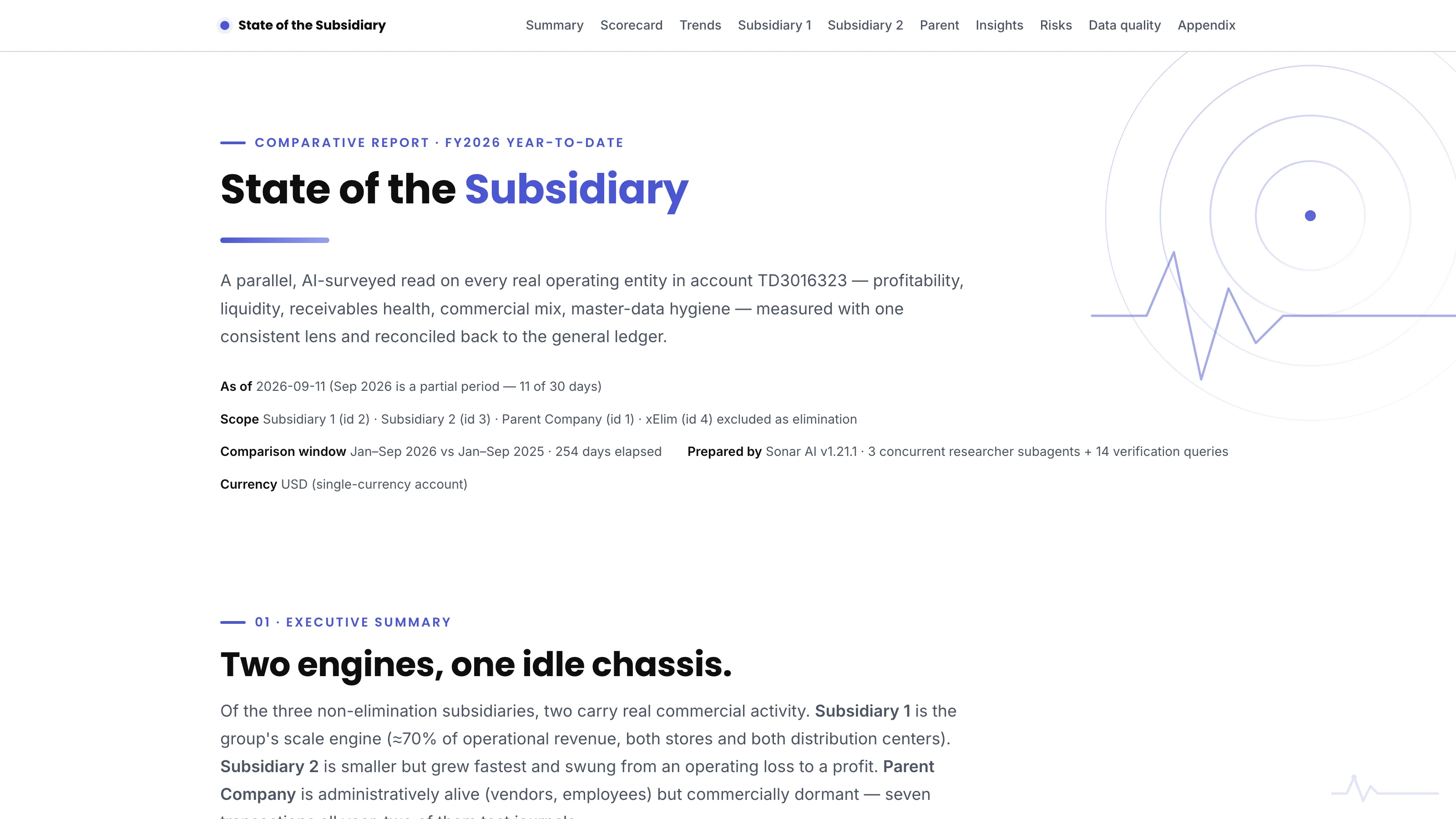
Phase one is parallel discovery. Three read-only researcher subagents ran concurrently, one per real subsidiary, with identical seventeen-point survey briefs: profit and loss in two lenses, margins, expense accounts, receivables and payables aging, cash, orders, volumes, location and category mix, top customers and items, master data, inventory, data-quality flags, and DSO. The aggregate was 80 tool calls and 179 seconds of wall-clock time. Two of the three hit their iteration caps after the P&L stage, and one produced the inflated figure.
Phase two is unified measurement. Every metric was re-measured centrally, reduced in a sandboxed worker, nine reductions plus five verification queries. Every figure published in the report comes from that pass, and the appendix says so in a sentence I'd want in every multi-entity report: the subagent summaries were used for discovery and anomaly hunting, and none of their numbers were published.
Phase three is reconciliation. General ledger receivables were split into synthetic and operational and compared with the invoice subledger. The monthly P&L series was rebuilt after an initial pass, keyed on a parsed start date, shifted every month by one because of a timezone artifact. The corrected series is the one shown.
Two Engines, One Idle Chassis
Of the three non-elimination subsidiaries on the test account, two carry real commercial activity.
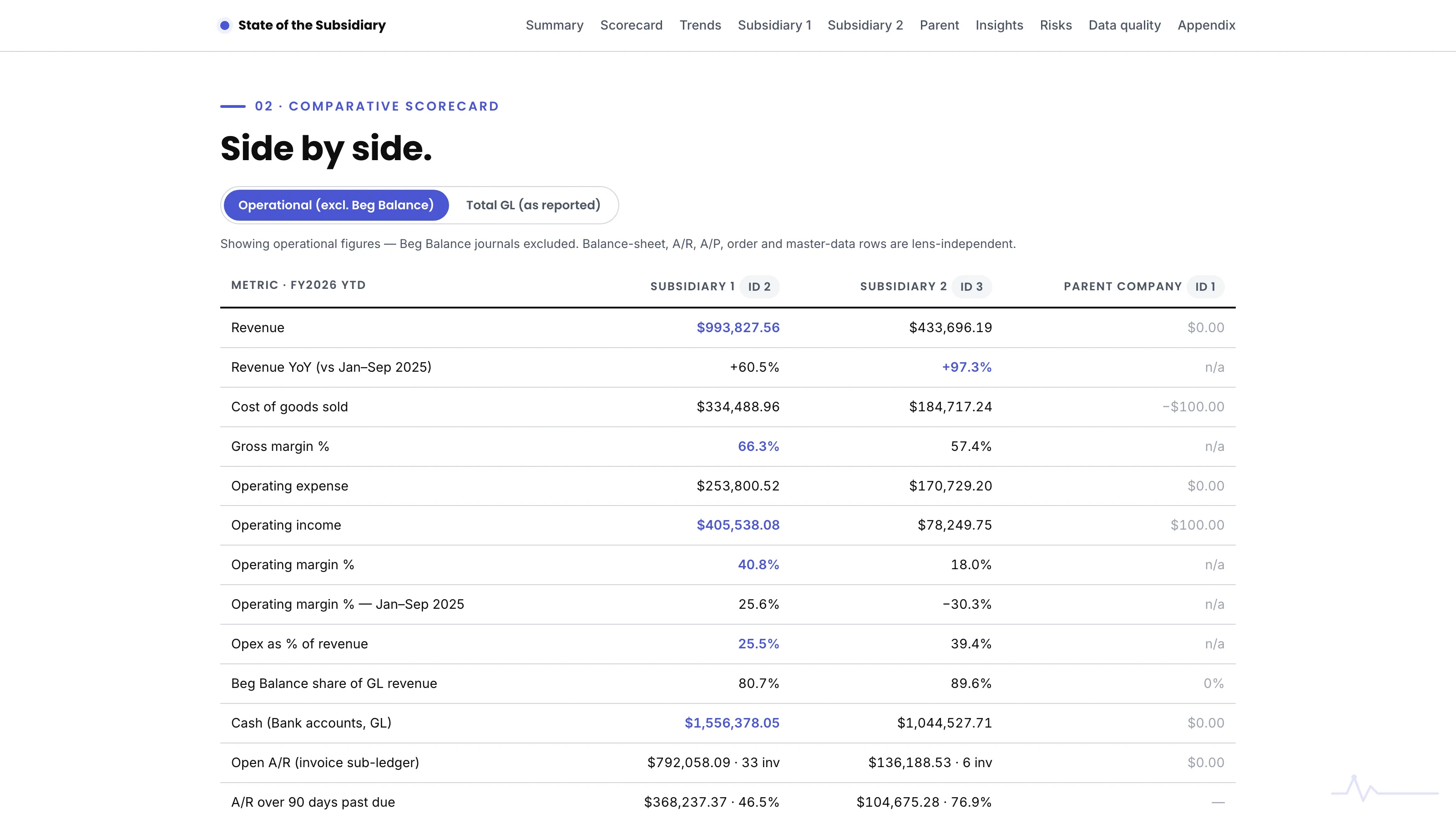
Subsidiary 1 is the scale engine: about 70% of operational revenue, both stores, both distribution centers, the inventory, the headcount, and the customer base. Revenue year to date is $993.8K, up 60.5%, at a 66.3% gross margin and a 40.8% operating margin. It also holds the receivables problem. Open receivables of $792K are 80% of year-to-date revenue, 46.5% of that is more than 90 days past due, and the implied DSO is about 202 days against terms that imply thirty. September operating expense tripled on a single $53K training bill from a vendor that is still unpaid.
Subsidiary 2 is a single-location wholesale operation out of Miami with seven buying customers and one employee. It doubled revenue to $433.7K and swung from a 30% operating loss to an 18% profit. It has zero open payables and $1.04 million in cash, the cleanest balance sheet in the group. And one invoice, from Red Rivers Consulting for $102.9K, is 24% of its year-to-date revenue and 144 days past due. If that name is familiar, then it's because the same invoice was a one-invoice whale in the concentration post. The report's advice is to forecast Subsidiary 2 as $330K recurring plus $103K one-off, and to assign a second responsible employee before scaling.
The Parent Company is administratively alive, with twenty vendors and three employees, and commercially dormant: seven transactions all year, two of them test journals, an orphan $655 receivable with no invoice behind it, and 100% of its vendors without payment terms. The report calls that a normal OneWorld pattern with a small clean-up attached, and doesn't inflate it.
The Headline Across the Group
The group is more profitable than it is liquid. Combined operational operating income of $483.8K sits against $928.2K of open customer invoices, of which $472.9K is more than 90 days past due. That's more than the group's entire first-quarter revenue. Five customers hold $477.5K of the open balance, and the recommendation is a targeted dunning cycle on the three that are past 245 days, plus a credit hold on the two accounts whose single invoices haven't been paid.
Every figure in the report is shown in two lenses, because the synthetic monthly journals on this account are 80.7% of Subsidiary 1's ledger revenue and 89.6% of Subsidiary 2's. The scorecard has a toggle. The narrative uses the operational lens throughout and says so at the top.
What Else It Noticed
A single service item accounts for $477.7K of group sales at about $4,700 a unit, with no class and no location on its lines, and it distorts every mix analysis in the account. Subsidiary 1 grew revenue 61% while cost of goods grew 17%, and the report says to check whether that's real before celebrating it, since $905K of inventory against $334K of year-to-date cost of sales is consistent with cost not being fully relieved. The Chicago distribution center holds $42.5K of stock and recorded no sales. Electronics has zero sales anywhere in the group. And 215 of Subsidiary 1's 260 active customers have no payment terms, which means most invoices default their due date and weakens every aging number above.
The data-quality register lists sixteen findings, each with a subsidiary, a count or amount, and the impact, with a severity marker for whether it affects reported financials, is a control weakness, or is only an analytical limitation. Two rows are marked clean.
Wrapping Up
The lesson the report recorded for itself was that when a subagent has to aggregate the general ledger, the brief should carry the exact join template rather than describing it. I think that it's the right kind of lesson for a report to leave behind, and it's the kind of thing that only appears when a document is honest about its own process.
State of the Subsidiary is in the paid tier of the library. The full sample report from the test account is online, and I covered the whole September release in a separate post.
If you've ever argued about whether two subsidiaries were measured the same way, then this is the report that ends the argument, because it can show you the one query that measured both.