The PE Value Creation Deck reprices every finding in my NetSuite test account's ledger as enterprise value at the sponsor's multiple, and the first thing it does with the largest cash finding is refuse to multiply it.
That's the discipline the prompt is built around. EBITDA levers compound at the multiple. Cash levers enter at one to one. The two are never blurred, and the deck says so in the caption of its first chart. It went into the Sonar AI Prompt Library in September as a quality-of-earnings-grade self-diligence: the findings a buyer's advisor would surface, found first, priced in EV terms, and paired with owned remediation levers. If you're new to this, Sonar AI is an AI agent that runs inside NetSuite. Every prompt in the library is a playbook that I engineered and tested against live NetSuite data, and you run it inside your own account, against your own records. Nothing leaves the account, and nothing is written to it.
The Bridge
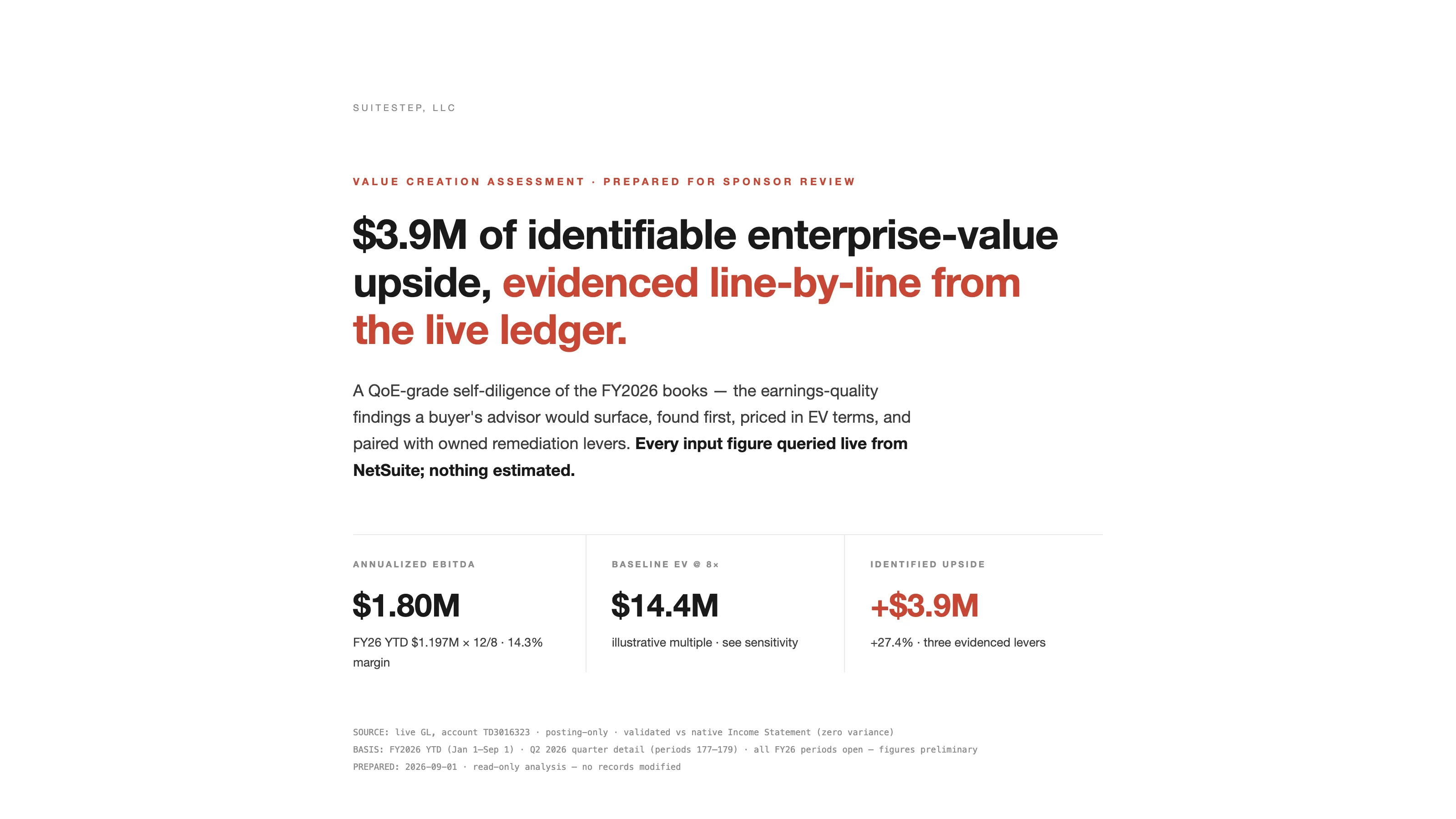
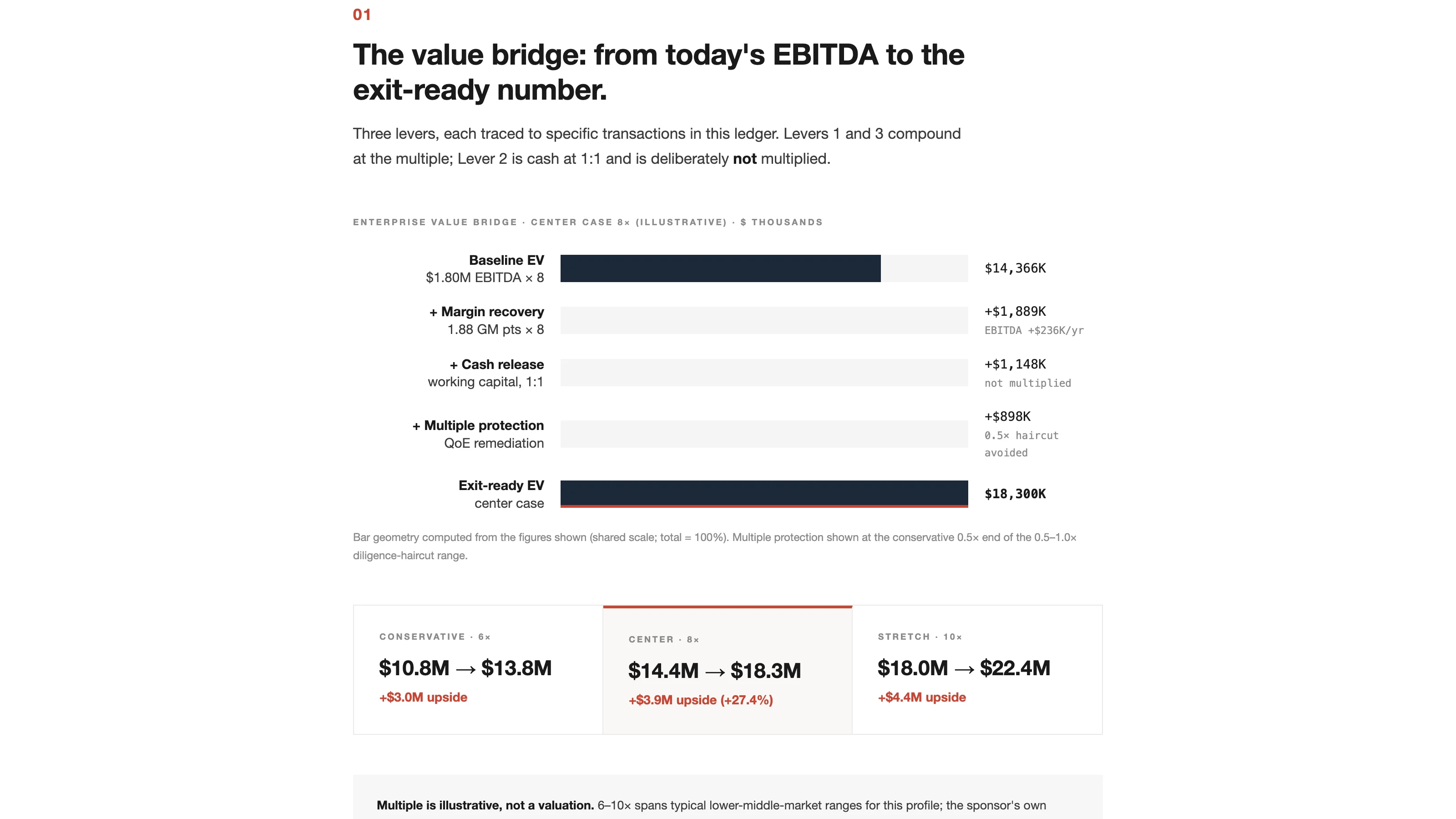
Annualized EBITDA is $1.80 million, which is the year-to-date figure of $1.197 million scaled by twelve over eight, at a 14.3% margin. At an illustrative eight times, baseline enterprise value is $14.4 million. Three levers take it to $18.3 million, which is $3.9 million of upside, or 27.4%.
The first lever is margin recovery. Gross margin compressed 1.88 points in one quarter while revenue grew 13.4%, and the first-quarter level is the target because this ledger produced it two quarters ago. Each recovered point is about $126K of annualized EBITDA, which at the center multiple is about $1.0 million of enterprise value. Recovering to the first-quarter level adds $1.89 million.
The second lever is cash. The company collects in 135 days on the honest basis and pays in 8, and the deck calls that 127-day gap the single most fixable number in the file, worth $6,857 of permanent cash for every day closed. Chasing the $559K of receivables past 90 days, bringing DSO to 75 on the organic book, and scheduling vendor payments to the due date release $1.15 million. That enters the bridge at one to one, and the chart labels it "not multiplied."
The third lever is multiple protection. Eighty-one percent of second-quarter revenue arrived through six anonymous monthly journals, and both control accounts miss their subledgers by about $1.2 million, diagnosed to the dollar as the journal-posted share. That's the finding a buyer's advisor bills six figures to discover, and unremediated it invites a haircut of half a turn to a full turn on an otherwise clean EBITDA, or an earnout structure. Documenting the journals and rebuilding the tie-out avoids the haircut, and at the conservative end that's worth $898K. The deck also makes a point I hadn't seen made before: the existence of this document, with the findings surfaced and owned before the process starts, is itself the mitigation narrative.
The multiple is illustrative and the deck says so repeatedly. Six to ten times spans typical lower-middle-market ranges for this profile, and the sponsor's own comparables govern. Every EBITDA and cash input beneath the multiple is queried. The haircut range in the third lever is market convention, labeled as such, and the deck calls it the only unqueried assumption in the document.
What a Buyer's Team Finds, Pre-Answered
The diligence readiness scorecard runs ten tests. Four are ready: organic growth quality, with invoiced revenue up 89.8% and no quarter-end loading; the EBITDA reconciliation, which ties to the native income statement with zero variance; operating leverage, with expenses flat against 29.5% revenue growth; and backlog integrity. Three are fixes, and all three are already scoped as the second and third levers. Three are watches: customer concentration, where the top two billers are also the top two receivables; cash conversion, where August was the first negative month; and a fixed-asset base of $6.5K of depreciation on $8.4 million of revenue, which means the assets are either absent or held outside these books.
The verdict line reads: four ready, three fix, three watch, nothing unexplained.
The Equity Story
The last page is the one-paragraph version a sponsor would repeat. Underneath a fixable reporting wrapper sits an asset-light distribution business growing its invoiced book 90% a year with flat costs, no leverage, and $2.6 million of cash, and its three biggest value levers are all within management's control. No market growth is assumed. No synergies. No multiple expansion. Every lever is self-help.
Where It Connects
This deck was prepared on the same day as the Ledger X-Ray, against the same account, and the two share their findings: the journal regime, the three DSOs, the control-account gaps. The X-Ray tells the story for a board. The deck prices it for a sponsor. The Scenario and Sensitivity Analysis in the same release takes the same EBITDA and stress-tests it instead.
The methodology footer is short because the queries live in a companion technical appendix: posting transactions only, EBITDA validated against the native income statement, DSO on organic quarterly revenue, every figure labeled with its basis. All FY2026 periods were open at preparation, so every figure is preliminary, and the income-tax line is zero in the ledger, which the deck flags to confirm rather than assumes.
Wrapping Up
PE Value Creation Deck is in the paid tier of the library. The full sample report from the test account is online, and I covered the whole September release in a separate post.
The multiple is the one labeled assumption. Everything beneath it was queried from the general ledger, and the deck would rather show you a bar that says "not multiplied" than a bigger number.