An earlier draft of this report said that gross margin on my NetSuite test account had compressed from 41.2% in the first quarter to 39.2%. The methodology review showed that the comparison rested on a single outlier month, March, at 45.6%. With March excluded there was no downward trend, and the sentence was withdrawn. A later draft called the cost basis "conservative." The prior-year fourth-quarter comparison showed it was roughly neutral, and that wording was changed too.
Both corrections are recorded in the report, in a paragraph headed "revision notes," and I think that they're the best argument for the prompt. Scenario and Sensitivity Analysis for a PE Portfolio Company builds a base case from live general ledger actuals, shocks it three ways, finds four breakevens, ranks the management levers by speed, and then runs sixteen adversarial checks on itself before it publishes. It went into the Sonar AI Prompt Library in September. If you're new to this, Sonar AI is an AI agent that runs inside NetSuite. Every prompt in the library is a playbook that I engineered and tested against live NetSuite data, and you run it inside your own account, against your own records. Nothing leaves the account, and nothing is written to it.
The Base Case Is a Proxy, and It Says So
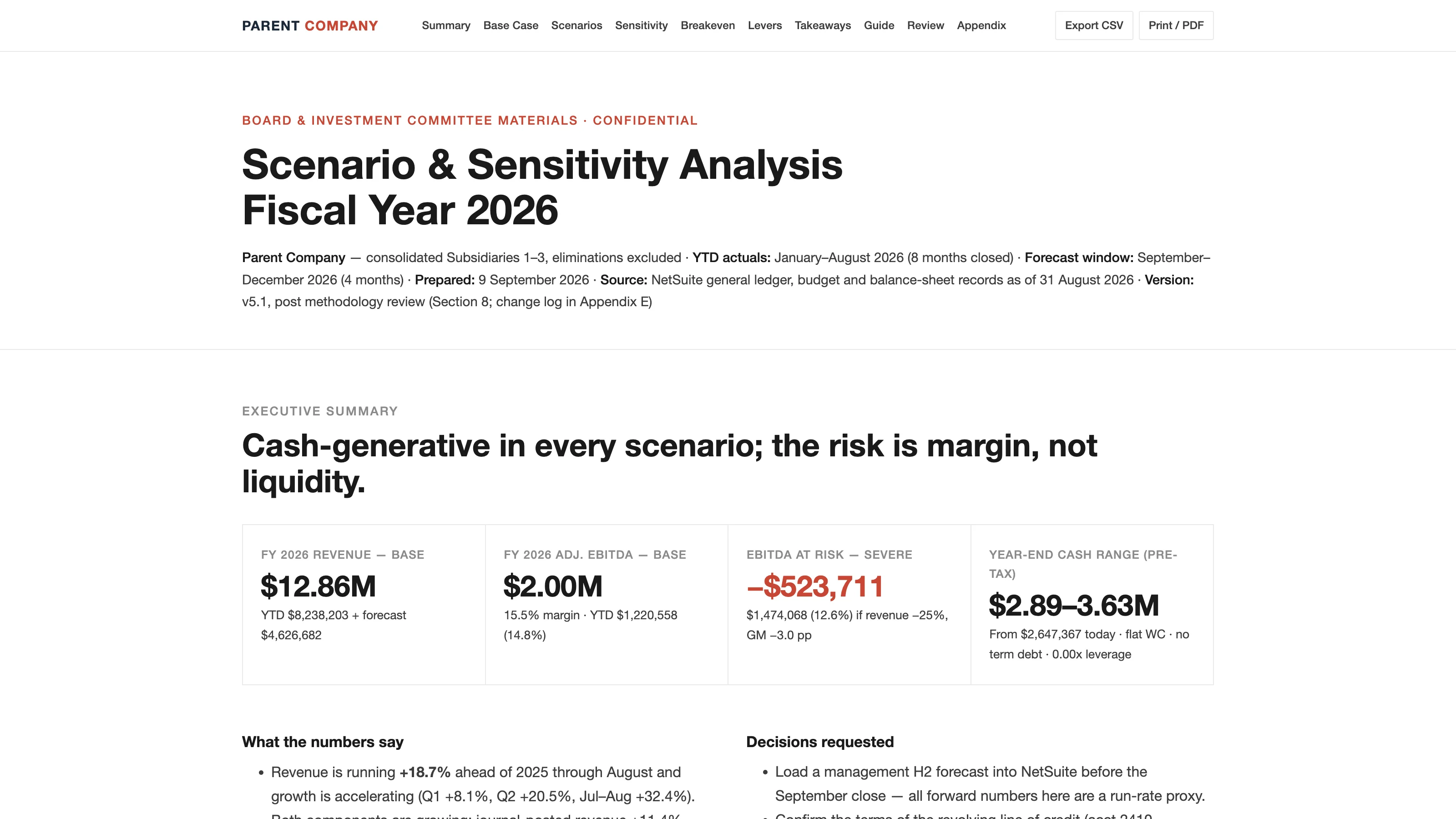
Eight months of 2026 are closed. No forecast or budget for September through December exists in NetSuite, because the loaded budget covers January through June only. So the base case uses a run-rate proxy: the same four months of 2025, multiplied by the year-to-date growth rate of 18.7%, which preserves seasonality. The report triangulates that against six other proxy methods, which range from $4.1 million to $5.2 million for the remaining window, and lands mid-range at $4.6 million. The first decision it requests is that management load a real forecast before the September close, because until then every forward number in the document is a placeholder.
On that basis, full-year revenue is $12.9 million and adjusted EBITDA is $2.0 million at a 15.5% margin. Year-end cash lands between $2.9 million and $3.6 million across the scenarios, pre-tax, with no term debt and a revolver that was drawn for $2,000 in August and repaid in September. Leverage reads 0.00 times, and the report says not to present that to an investment committee until someone confirms whether the sponsor holds debt above this entity.
Cash-Generative in Every Scenario
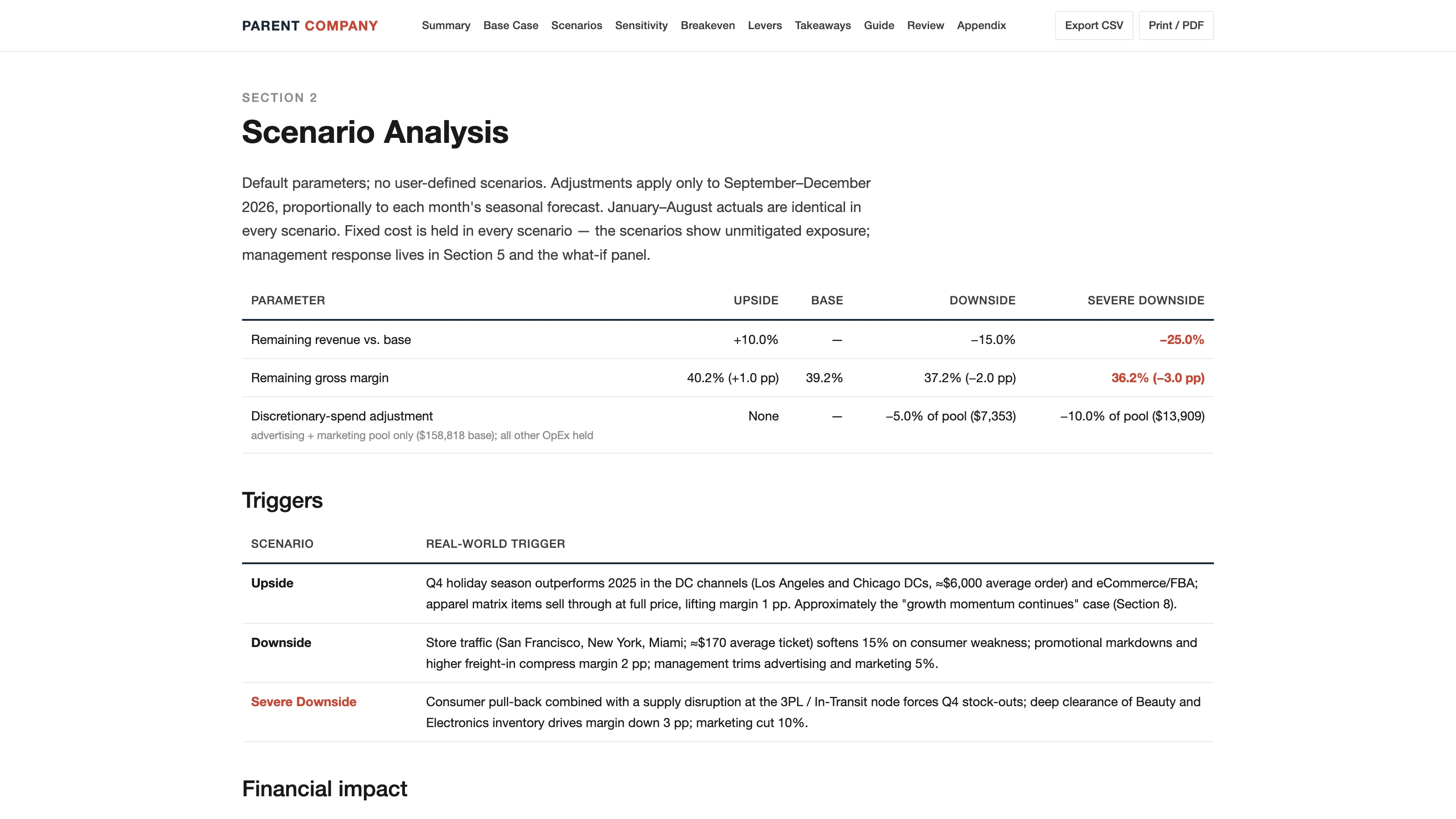
Upside, downside, and severe downside are stress tests at fixed shock sizes, plus ten percent, minus fifteen, and minus twenty-five on remaining revenue, with margin moves of plus one, minus two, and minus three points. Because eight months are already booked, the severe case cuts full-year revenue by only 9%. Every month remains EBITDA-positive in every scenario, and the thinnest month is a severe November at $53K.
Fixed operating cost is $239,215 a month. EBITDA breakeven would need a 44.8% collapse in remaining revenue. Cash breakeven is unreachable within the year even at zero revenue, which leaves 10.9 months of runway. Operating leverage is modest, and the business absorbs a 25% volume shock and still earns a 12.6% EBITDA margin.
So the verdict is that the risk is margin. Gross margin has ranged from 37.9% to 45.6% month to month this year with no trend, and each point on the remaining window is worth $46,267 of EBITDA. Moves of two points or more between adjacent months have happened four times in 2026, which means that the downside scenario's two-point compression is a routine monthly event rather than a tail case. The tornado chart shows a 10% revenue move outweighing everything else, and then a second bar that's new in this version: a repeat of 2025's fourth-quarter cost seasonality, which would cost about $74K and roughly cancels the $56K of cushion in the year-to-date cost basis. That's why "conservative" became "neutral."
Working Capital Is the Route to the Warning Line
No revenue scenario reaches the $2.4 million cash warning threshold on its own. The severe scenario plus a ten-day slip in collections and a fifteen-day slip in inventory ends the year at $2,228,565, below it. The report couples every scenario with a working-capital stress table for that reason, and notes that a ten-day DSO move is worth $35,246 per day.
The consolidated DSO is 62 days and reads green. Subsidiary 2's is 75 and reads red, on $1.4 million of the group's $2.1 million receivables. Bringing it to the consolidated figure alone releases about $248K with no EBITDA cost, and the report recommends starting that program regardless of scenario. It also caveats it: about $1.24 million of the consolidated receivables balance originates from the synthetic monthly journals on this account, so the lever should be sized on the transactional share, roughly $145K, until the collectibility of the rest is confirmed.
Levers, Ordered by Speed
Six responses if the downside materializes, fastest first, each with a timeline, an annual impact, a cash impact, and a trade-off. A travel freeze in zero to two weeks. A marketing pull-back in two to four, with the warning that cutting demand generation in October through December is the lever most likely to turn a downside into a severe downside. Receivables acceleration in 30 to 60 days. Vendor renegotiation in 60 to 90. Inventory reduction in 90. A hiring freeze at 90 plus. The maximum defensive response is about $986K of cash, and the report says that number falls to about $779K if only the transactional share of receivables is counted.
There's a personnel finding buried in the assumptions that I'd want a CFO to see: the ledger's personnel accounts work out to $25,684 per head per year across 50 employee records, which is implausibly low for a fully loaded cost, so either payroll is partly posted elsewhere or the headcount includes inactive records.
Signal to Action
The section I'd hand to a board is the playbook. Every early-warning indicator has a current value, a threshold, and a frequency, and every threshold is wired to a pre-agreed response with a decision owner. One month more than 7% below forecast means flag and check backlog, no spend changes. Two consecutive months below means trigger the travel freeze immediately. Trailing three-month margin under 38% means a merchandising review and the fourth-quarter margin floor. Cash under $2.4 million while EBITDA is on plan means a working-capital leak, and the instruction is to reconcile receivables and inventory by subsidiary and not to cut operating expense in response to a working-capital signal.
There's an interactive what-if panel in the document, so when a director asks what happens if margin drops another point and fixed cost is cut 5%, the answer is available in the meeting.
Sixteen Checks
Section 8 is a structured self-review that ran after the model was built and tied out. The first pass produced twelve findings. A second pass added four more. Between them they changed the margin narrative, added the working-capital stress table, disclosed the fourth-quarter cost exposure, and moved the DSO indicator and lever from consolidated to subsidiary level. The report tests both extreme alternatives of its cost-behavior classification and reports that no conclusion changes under either, though the slope of the sensitivity line moves between 35.7% and 39.2%.
Every figure derives from the queries in the appendix, and the report includes a refresh cadence: weekly for DSO and cash, monthly within five business days of close for the full re-run, including the review battery.
Wrapping Up
The PE Value Creation Deck in the same release takes the same account and prices its findings as enterprise value instead of as scenarios. Together they're the two documents a sponsor would want before an investment committee, and both go out of their way to label the one number in each that wasn't queried.
Scenario and Sensitivity Analysis for a PE Portfolio Company is in the paid tier of the library. The full sample report from the test account is online, and I covered the whole September release in a separate post.
Most scenario models start from a spreadsheet. This one starts from the ledger, and it's the only one I've seen that writes down what it got wrong the first time.