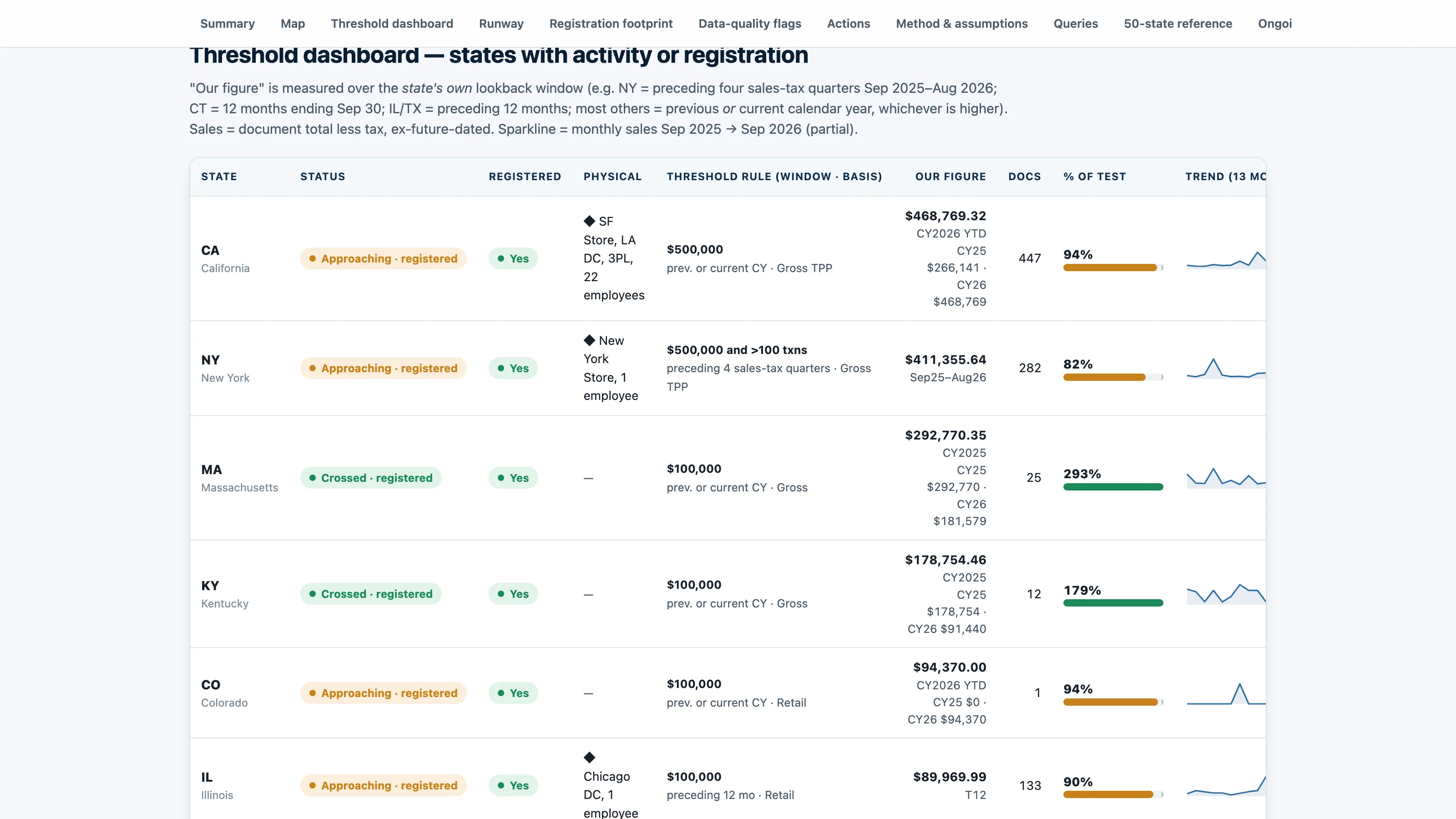
Colorado's economic nexus threshold is $100,000 of retail sales in the previous or current calendar year. My NetSuite test account has $94,370 of Colorado sales in 2026, all of it one invoice to one customer in March. Headroom is $5,630. One more order of any size above that establishes nexus.
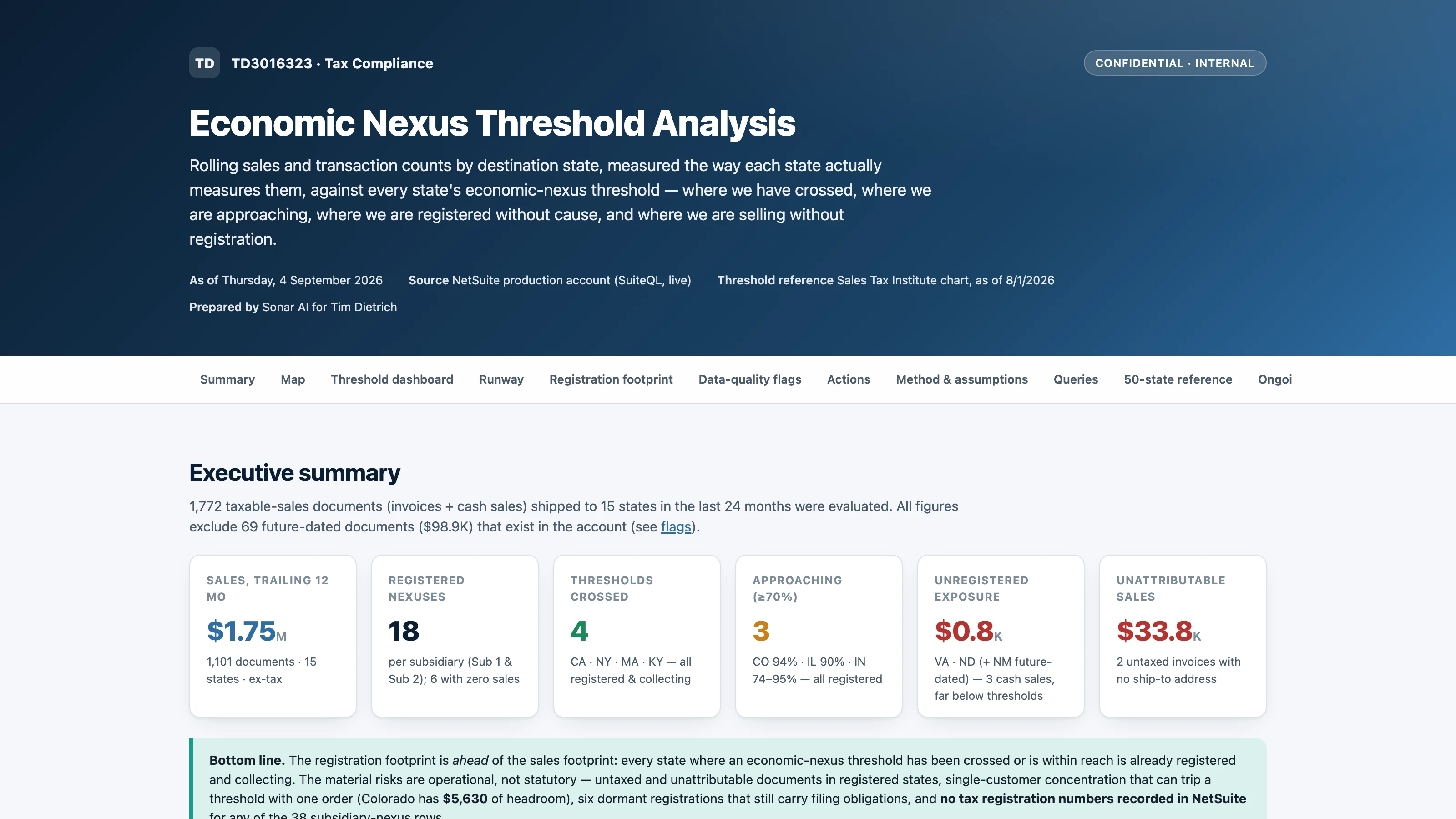
That's fine, because the company is already registered in Colorado and collecting tax. What isn't fine is the pair of $16,884 invoices to one customer in August with no shipping address, no billing address, zero tax, and a nexus that defaulted to California. They can't be attributed to any state, and if the goods went to a registered one, they're under-collected.
The Economic Nexus Threshold Analysis measures rolling sales and transaction counts by destination state the way each state measures them, against every state's threshold. It went into the Sonar AI Prompt Library in September. If you're new to this, Sonar AI is an AI agent that runs inside NetSuite. Every prompt in the library is a playbook that I engineered and tested against live NetSuite data, and you run it inside your own account, against your own records. Nothing leaves the account, and nothing is written to it.
The Way Each State Counts
This is the part that makes the prompt worth running rather than eyeballing a sales-by-state report. New York tests $500,000 of receipts and more than 100 sales over the immediately preceding four sales-tax quarters, and both conditions must hold, so the binding ratio is the lower one. Connecticut's year ends September 30. Illinois and Texas use the preceding twelve months. Most other states use the previous or current calendar year, whichever is higher, and some test either a dollar figure or a transaction count, where the higher ratio governs. Illinois repealed its 200-transaction test in January 2026 and Kentucky repealed its version in August, and the report carries both changes.
The dashboard shows every state with activity or registration, with the rule, the window, the company's figure over that window, the document count, the percentage of the test, a thirteen-month sparkline, and the tax collected. 1,772 taxable-sales documents shipped to fifteen states over 24 months, with 69 future-dated documents worth $98,900 excluded from every figure and flagged separately.
Where It Stands
Four thresholds crossed: California and New York, where physical presence already requires registration, and Massachusetts and Kentucky, where economic nexus was established on sales alone. All four are registered and collecting. Three states approaching: Colorado at 94%, Illinois at 90%, and Indiana at 74% of the calendar-year test and 95% trailing twelve months. All three registered. The runway section projects crossing months from the trailing three-month run rate, with the caveat that several of these states are single-customer, so one purchase order changes the answer.
The report's own summary is that the registration footprint is ahead of the sales footprint, and the material risks are operational rather than statutory.
The Operational Risks
The two unattributable invoices are finding four and the highest-priority fix. Finding five is Illinois, where 66 of 133 trailing-twelve-month documents carry zero tax despite a registration and a distribution center in the state, and the report says they're either legitimately exempt customers who should have certificates on file or a missing tax code on the cash-sale form. Finding six is six registered states with zero sales in 24 months, five of which generate zero-return filing obligations for nothing, and one of which is correct because an employee lives there. And every one of the 38 tax-registration rows in the account has a blank registration number, which means that the system can't evidence a registration and returns may print blank permit numbers.
Kentucky, Indiana, Colorado, and Michigan trailing sales each come from exactly one customer. Kentucky's 2025 crossing carries the obligation through all of 2026 even though 2026 sales are under the line. Three trivial cash sales went to unregistered states, correctly untaxed, and the report notes them as the first out-of-footprint consumer shipments in the dataset.
What It Recommends
Fix the two addressless invoices today. Reconcile the 66 untaxed Illinois documents within two weeks and correct the form default if it's an error. Record the registration numbers and add a quarterly control that no active nexus has a blank one. Confirm destination-sourced local rates on the Colorado customer before the next order. Confirm or retire the five dormant registrations, and file final returns where nothing supports them. Resolve whether the Amazon fulfillment location holds inventory, because inventory in a fulfillment center creates physical nexus wherever Amazon stores it and nothing in NetSuite shows where that is. Decide with counsel whether the two operating subsidiaries are separate registrants, since thresholds apply per taxpayer and this report tests consolidated as the conservative view. And run the monitoring query on the first business day of each quarter.
How It's Built
Seven SuiteQL queries with a reducer over 1,841 header rows. Sales are document total less tax, which includes shipping charges because most states do. The assumptions section explains where the measurement basis is deliberately conservative: gross sales are used everywhere, which overstates the figure in states that test taxable or retail sales, and exempt sales are identified only by zero tax, which conflates exemption with tax-code errors. Thresholds were transcribed from a published chart dated August 2026, and the report says to verify against each state before acting, and that it isn't legal advice.
Wrapping Up
Economic Nexus Threshold Analysis is in the paid tier of the library. The full sample report from the test account is online, and I covered the whole September release in a separate post.
The statutory picture on the test account was clean. The two invoices with no address were the finding, and no sales-by-state report would have shown them.