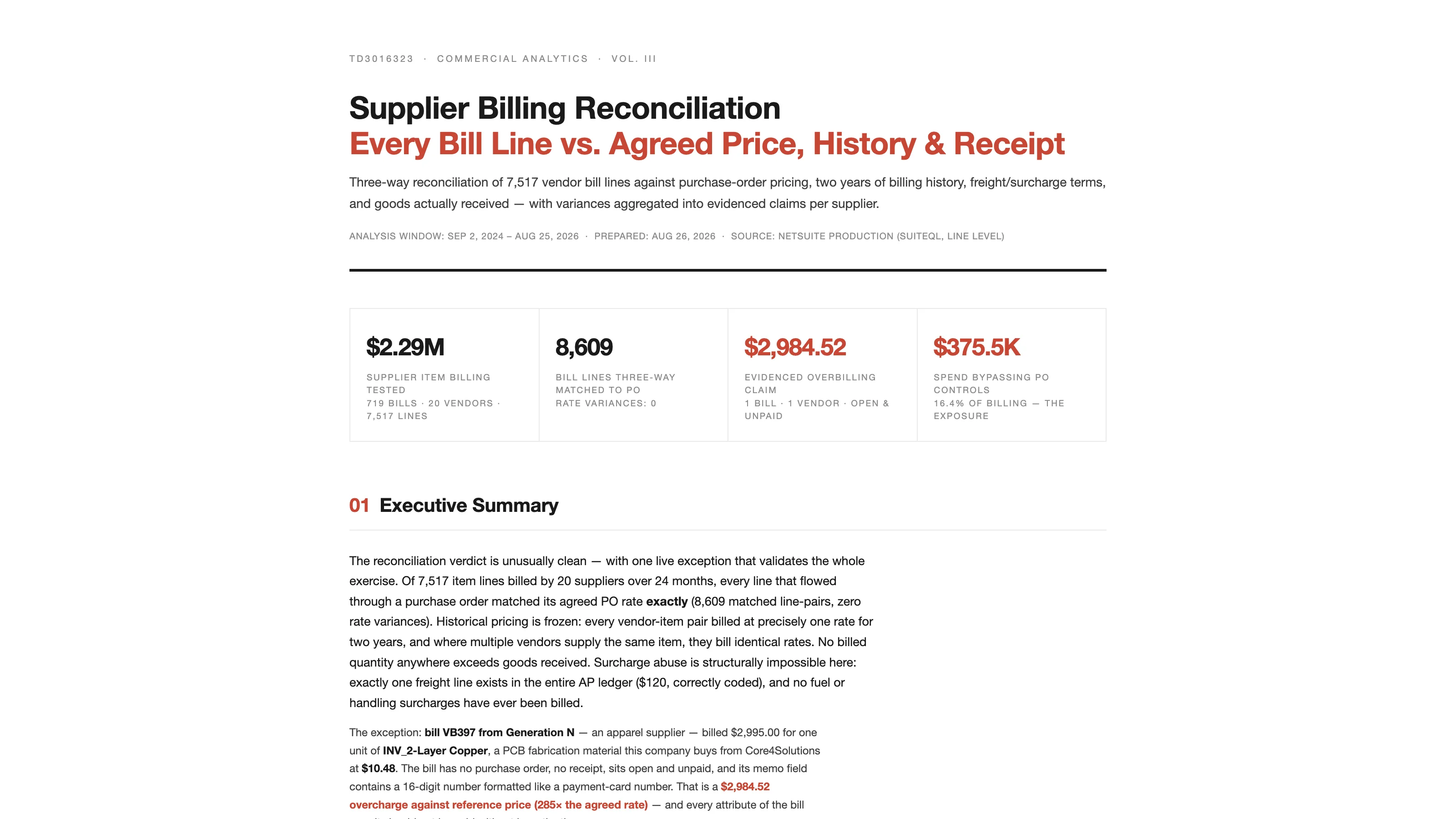
7,517 vendor bill lines. Twenty suppliers. Two years. Zero rate variances against purchase orders on all 8,609 matched line pairs. Every vendor-item pair on my NetSuite test account billed at exactly one rate for the entire window, and where two vendors supply the same item, they bill identical rates.
And one bill for a $10.48 part billed at $2,995.00, with a sixteen-digit number in the memo field.
The Supplier Billing Reconciler treats a clean result as a finding, and it treats the one exception as the place to look next. It went into the Sonar AI Prompt Library in September. If you're new to this, Sonar AI is an AI agent that runs inside NetSuite. Every prompt in the library is a playbook that I engineered and tested against live NetSuite data, and you run it inside your own account, against your own records. Nothing leaves the account, and nothing is written to it.
Four Tests on Every Line
The prompt reconciles every vendor bill item line three ways: against the agreed price on its purchase order, against the vendor's own billing history for that item and against what other vendors bill for the same item, against any freight, fuel, or handling surcharge, and against the quantity received. Bill lines link to their purchase orders through the created-from field on each line, and item receipts link to the same orders the same way, which gives a three-way match between what was agreed, what arrived, and what was charged.
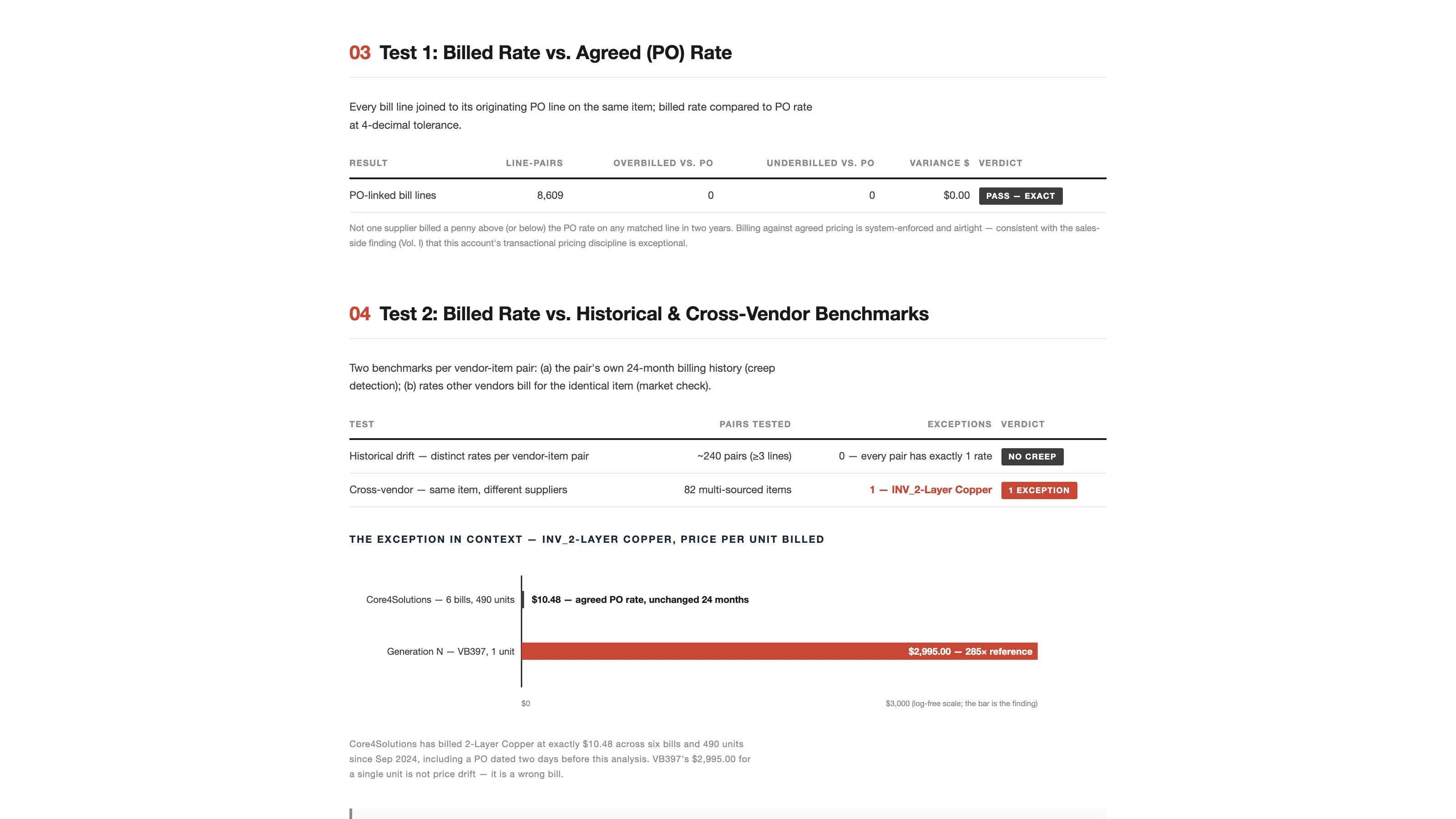
On the test account, 99.6% of lines flowed through a purchase order, which the report calls exceptional coverage and the reason the reconciliation is near-total. Test one, billed rate against purchase-order rate at four-decimal tolerance, returned zero rows. Test two, distinct rates per vendor-item pair over 24 months, returned zero rows, because every pair has exactly one rate. There's no creep to detect and nothing for small per-unit differences to compound into, because there are none. Test three found exactly one freight line in the entire payables ledger, $120 from a carrier, correctly coded, and no fuel or handling surcharges ever billed by anyone. Test four found no supplier billing for goods not received.
The report says why the rest is silent. Cost parity across suppliers plus frozen two-year rates leaves no gradual-creep claim to accumulate. That's consistent with the sales-side finding in the pricing study that transactional pricing discipline on this account is exceptional in both directions.
The Exception
Bill VB397 from Generation N, an apparel and leather-goods supplier, billed $2,995.00 for one unit of a printed-circuit-board fabrication material that the company buys from a different vendor at $10.48, a rate that has been stable for 24 months with a purchase order dated two days before the analysis. The bill has no purchase order and no receipt. It's open and unpaid, so payment can still be stopped. The item is outside the vendor's category. And the memo field contains a sixteen-digit numeric string formatted like a payment-card number, which the report flags as a separate data-handling concern regardless of how the billing question resolves.
That's 285 times the agreed rate. The claim is $2,984.52 if the bill is genuine but mispriced, and the full $2,995.00 if nothing was ordered or received. The recommendation is a payment hold today, confirmation with purchasing, a documented dispute or void, and redaction of the memo either way.
The Channel That Produced It
The structural finding underneath the exception is the one that matters. $375,533 of billing, 16.4% of supplier spend, bypassed purchase orders entirely. That's 29 lines out of 7,517, four tenths of a percent, and they carry 16.4% of the dollars because off-PO bills average $12,950 a line against $256 for PO-linked lines. Most of them are eight manually keyed bills from Generation N whose rates happen to match the vendor's standard prices exactly, so no additional claim arises from them. But they were never protected by the three-way match, and VB397 is what that unprotected channel eventually produced.
The report puts it in one sentence: the off-PO door is the risk, and the pricing isn't.
Received, Not Billed
The one direction that did produce a number is goods received with no invoice: 208 purchase-order and item combinations worth $32,988 at purchase-order rates. That runs in the company's favor for cash and distorts accrued liabilities and inventory if it isn't booked, and it's concentrated in the beauty and apparel suppliers with small receipts awaiting invoices. One supplier shows 40 units received against 20 billed on two orders, which the report says to verify as a real count rather than a receiving error before anyone chases it.
What It Recommends
Hold and investigate VB397 today. Close the off-PO channel by requiring a purchase-order reference on vendor bills above a threshold, enforced at entry. Book the accrual. Adopt the four queries in the appendix as standing monthly controls, since each test is one query, and the month a supplier starts drifting they'll return it on day one.
And one recommendation about what to leave alone: don't launch a broad supplier-recovery program. The evidence shows that supplier billing conduct on this account is close to perfect, and recovery-audit effort should point at the manual-entry door and its one live exception rather than at compliant suppliers.
How It's Built
Five SuiteQL queries in the appendix, four of them meant to run monthly. The assumptions are stated: the purchase-order rate is the agreed price because no contract or price-list module is in use, freight terms are verified by the absence of surcharge lines because no vendor contracts exist in NetSuite, and intercompany allocation bills are out of scope. The report notes that the header-level link table carries only bill-to-payment links on this account, so the purchase-order lineage lives entirely on the line-level created-from field.
Wrapping Up
The companion Duplicate Payment and Credit Recovery Ledger picks up the same vendor from the other side, and the sixteen-digit number in VB397's memo turns up again there as the document number on an unapplied credit.
Supplier Billing Reconciler is in the paid tier of the library. The full sample report from the test account is online, and I covered the whole September release in a separate post.
A clean file is good news. The one exception is where you look next.