If a lender pulled the accounts receivable aging on my NetSuite test account today, then they'd see $473,000 more than 90 days past due. All of it is 33 invoices with a memo that starts with "TEST." Until those are voided or reclassified, no financial statement from this account should go to a bank.
That's the first of three conditions precedent in the Line of Credit Readiness report, and it comes before the sizing, the ratios, and the document list, because a lender who discovers a test-invoice block after the fact stops trusting every other number in the package. The prompt answers three questions: how much can we get, what will they ask for, and what should we fix first. It went into the Sonar AI Prompt Library in September. If you're new to this, Sonar AI is an AI agent that runs inside NetSuite. Every prompt in the library is a playbook that I engineered and tested against live NetSuite data, and you run it inside your own account, against your own records. Nothing leaves the account, and nothing is written to it.
The Profile, on a Lender's Basis
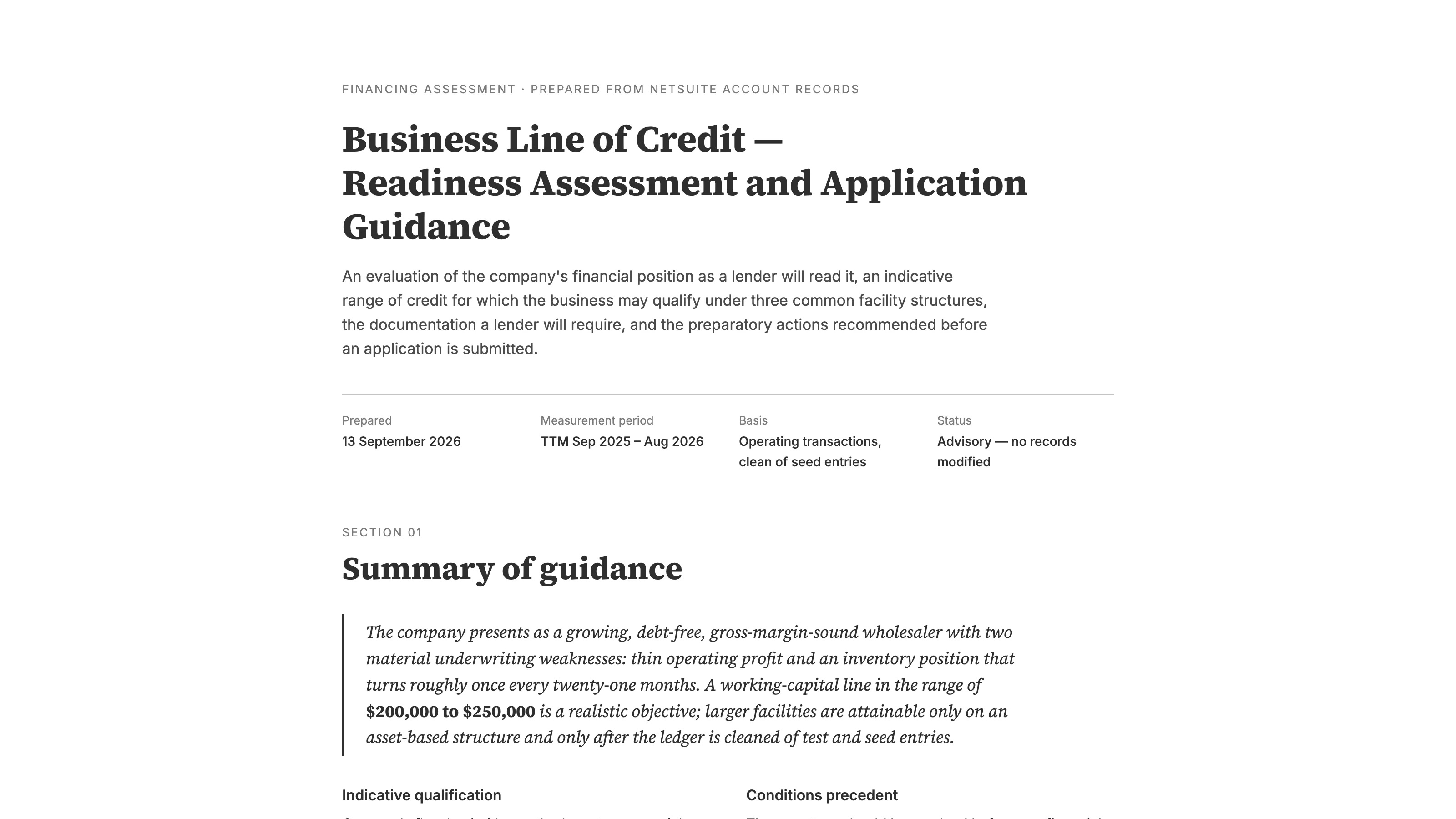
Everything in the report is computed clean of the test invoices and the synthetic monthly journals, because that's what a credit officer would see once the clean-up is done. On that basis the company is a growing, debt-free wholesaler with a sound gross margin and two material underwriting weaknesses.
Trailing twelve-month revenue is $1.16 million, up 35%. Gross margin is 45.7% and has stayed between 41% and 48% every month, which the report says to lead with. Operating margin is 3.2%, EBITDA margin 4.8%, both below the thresholds a lender applies. No interest-bearing debt exists. Clean receivables are $161K at 51 days sales outstanding. Payables are 97% current. And inventory at cost is $1.12 million, turning 0.56 times a year, or roughly 652 days of supply.
The ratio table puts each figure next to a typical lender threshold, an assessment, and the derivation. Gross margin and growth are strong. Profitability is below. Interest coverage on a pro forma $250K line at 9.5% is 2.4 times, adequate. Debt to EBITDA fully drawn is 4.5 times, at the upper limit. The quick ratio, with cash excluded for a reason I'll get to, is 0.35 and weak. Inventory turns are weak. The largest customer is 15% of revenue, within the 25% limit, and the top ten are 82%, which will be noted.
There's a correction in the middle of that section that I appreciated. An earlier internal analysis had quoted inventory turns of 1.8. That figure inverted the ratio. The report states the correct computation, cost of goods sold divided by inventory, gives 0.56, and explains why that single number is the balance-sheet item most likely to constrain the facility.
Sizing
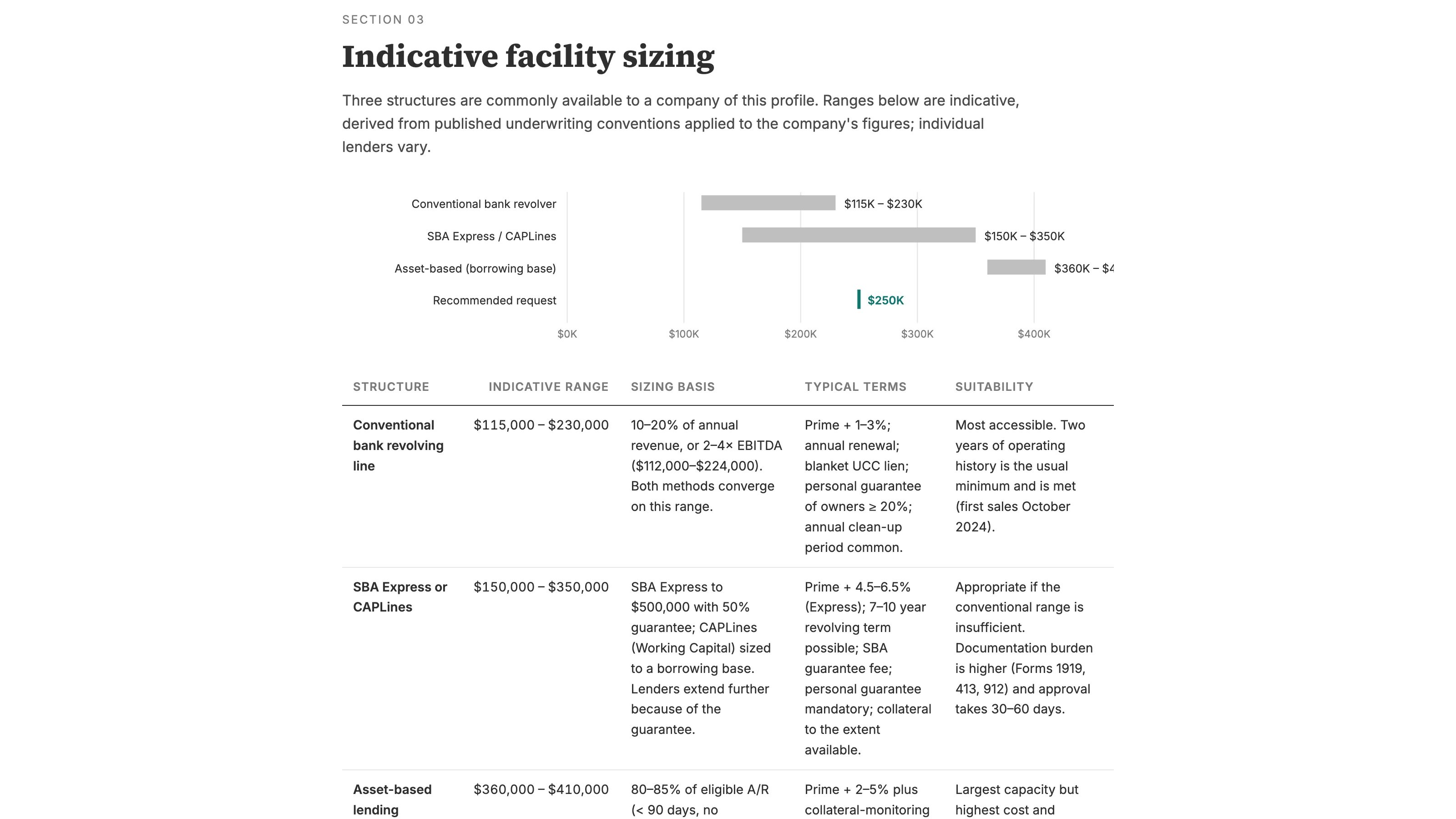
Three structures, with ranges derived from published underwriting conventions and labeled as indicative rather than quotations. A conventional bank revolver supports $115K to $230K, sized two ways that converge. An SBA-guaranteed line widens that to $150K to $350K, at higher documentation burden. An asset-based facility could reach $360K to $410K, subject to a field examination and an inventory appraisal that will discount slow-moving stock heavily.
The recommended request is $250K, positioned as seasonal working capital. It covers the largest single-month cash shortfall in the period, $125K in June 2026, twice over. Fully drawn it's 4.5 times trailing EBITDA, at the upper edge of what a cash-flow lender accepts, and defensible only if the line is presented as revolving. The report says to show a drawdown schedule that revolves to zero at least once a year, and it says what not to present: the line as a way to fund operating losses or to finance the existing inventory, both of which read to a lender as a term-loan or equity need.
The Cash Problem Underneath
The general ledger reports $2.57 million in bank accounts. The report traces that: $2.84 million was established by the seed journals and $820K by capital journals, and operating transactions since inception net to an outflow of $1.06 million. So the ledger can't be relied on for the company's actual cash position, the quick ratio excludes cash, and bank statements have to be the sole source of cash figures supplied to a lender. That's the second condition precedent.
The third is $228K of sales-tax payable across thirteen states. Lenders treat trust-fund liabilities as a threshold item, and delinquency is disqualifying, so the report says to reconcile to filed returns and obtain good-standing letters before applying.
Cash-Flow Pattern
Monthly inflows rose steadily from about $90K to about $130K. Outflows surged from March and peaked at $241K in June. Over the final six months, disbursements exceeded receipts by $404K, and the report reads that as the cash cost of building inventory to $1.1 million ahead of sales. A lender will read it as growth-driven working-capital strain rather than operating loss, which is the correct framing, provided the company can show the inventory is saleable and turns will improve. The recommended statement of use is narrow: bridge vendor terms to the holding-and-collection cycle, fund seasonal stock build, and hold a reserve for the Midwest distribution launch.
What the Lender Will Require, and What to Do First
The document list covers business financials, ownership records, personal financial statements for any owner over 20%, a narrative, and the additional forms for SBA programs, with the NetSuite report that produces each item where one exists. Then an eight-step preparation sequence. Steps one through four are the conditions precedent plus closing FY2026 so two complete tax returns exist. Steps five through eight improve the terms: reduce inventory before the balance-sheet date, re-base advertising from 21% of revenue to 12% and present the pro forma, where operating income rises from $36.6K to about $145K, convert the top-ten concentration into a tenure argument, and approach two or three lenders concurrently, starting with the depository bank.
Limits
The report is advisory, prepared from accounting records without independent verification, tax filings, bank statements, or knowledge of the owners' credit. It flags that payment dates in the ledger, a median of zero days to pay, are inconsistent with a 51-day DSO, so the lender's analysis will rely on bank statements for that point. Nothing was modified.
Wrapping Up
The inventory finding here is the same one the Cost and Gross Margin Review diagnoses in depth. That report tells you what to sell down. This one tells you what a credit officer will think of it.
Line of Credit Readiness is in the paid tier of the library. The full sample report from the test account is online, and I covered the whole September release in a separate post.
Find the test invoices before the credit officer does.