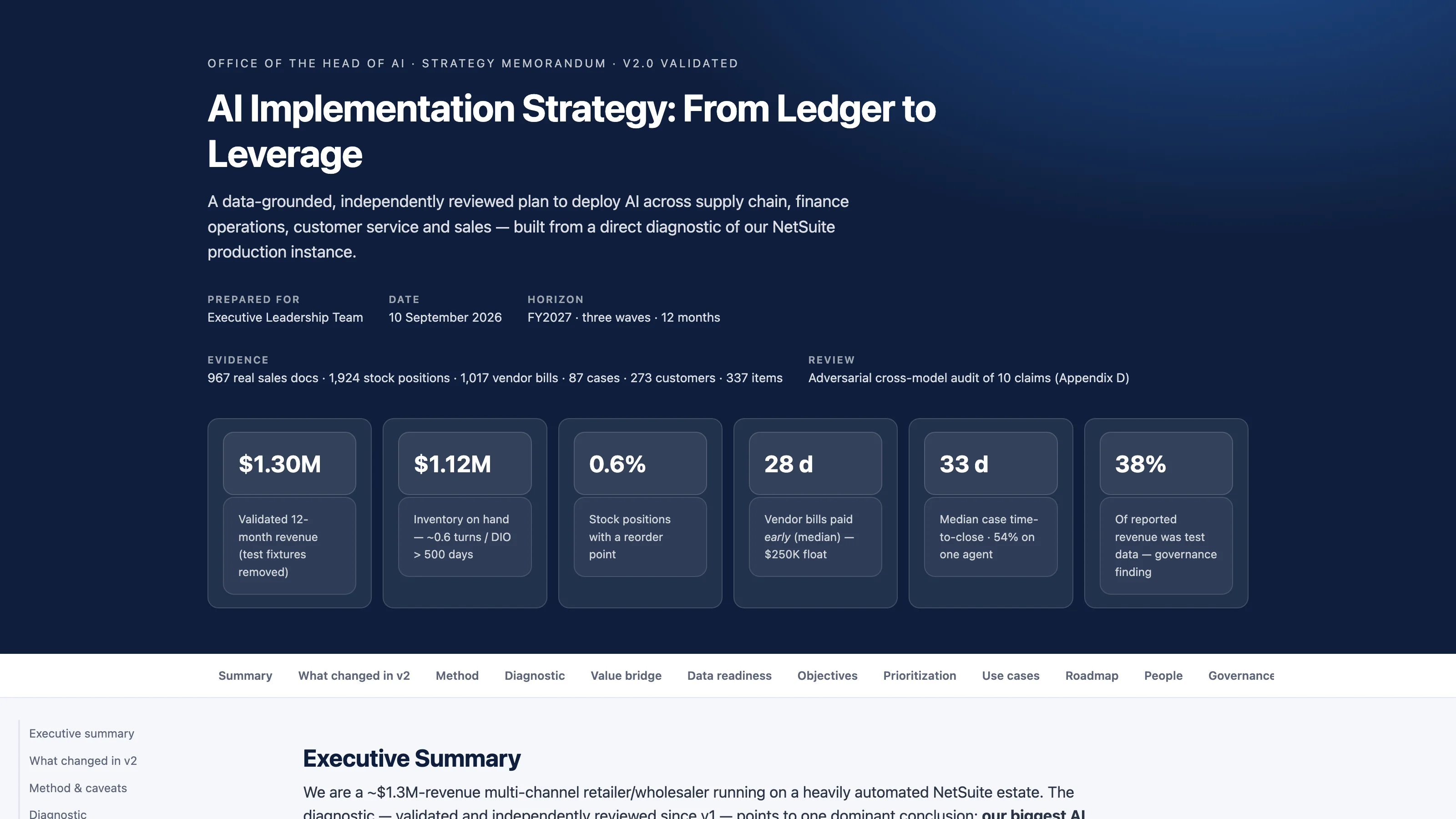
The first version of this strategy said that 51% of receivables on my NetSuite test account were more than ninety days overdue, $473,000, and it made collections the number one objective. The second version says that 31 of 39 open invoices are test fixtures with a creation date after the analysis date and no source order, that real open receivables are $138,000 with one invoice past due, and that collections is a watch item. The same fixtures had inflated reported revenue by 38%.
That correction is at the top of the executive summary, in a box, with a table of everything else that changed between versions and why. The AI Implementation Strategy prompt packages every headline claim with its source data and formulas and sends it to a different AI model acting as adversarial reviewer before the document ships. Ten claims were audited, six confirmed, four challenged and corrected. It went into the Sonar AI Prompt Library in September. If you're new to this, Sonar AI is an AI agent that runs inside NetSuite. Every prompt in the library is a playbook that I engineered and tested against live NetSuite data, and you run it inside your own account, against your own records. Nothing leaves the account, and nothing is written to it.
Decisions, Not Data Entry
The diagnostic's dominant conclusion is that the biggest AI opportunity on this account is in decisions rather than in data entry. The estate is heavily automated already, with 1,857 active script deployments, and business-user edits through the interface over ninety days were negligible. The reviewer challenged the first version's reading of that measurement, since system notes capture configuration edits rather than transaction entry, and the conclusion was reframed rather than dropped. The report's line is that the data-entry automation return most AI pitches lead with doesn't exist here.
What does exist: inventory turning about 0.6 times a year, with twelve of 1,924 stock positions carrying a reorder point and zero carrying a lead time. Vendor bills paid a median of 28 days before their due date, 995 of 1,005 payments, which the report prices as $250,000 of float returned to vendors for nothing. A service queue with a 33-day median close, a 62-day median open age, and 54% of cases on one agent. And master data too thin for any model to reason with: 80% of customers with no payment terms, 76% with no sales rep, 91% of items with no class.
The Value Bridge
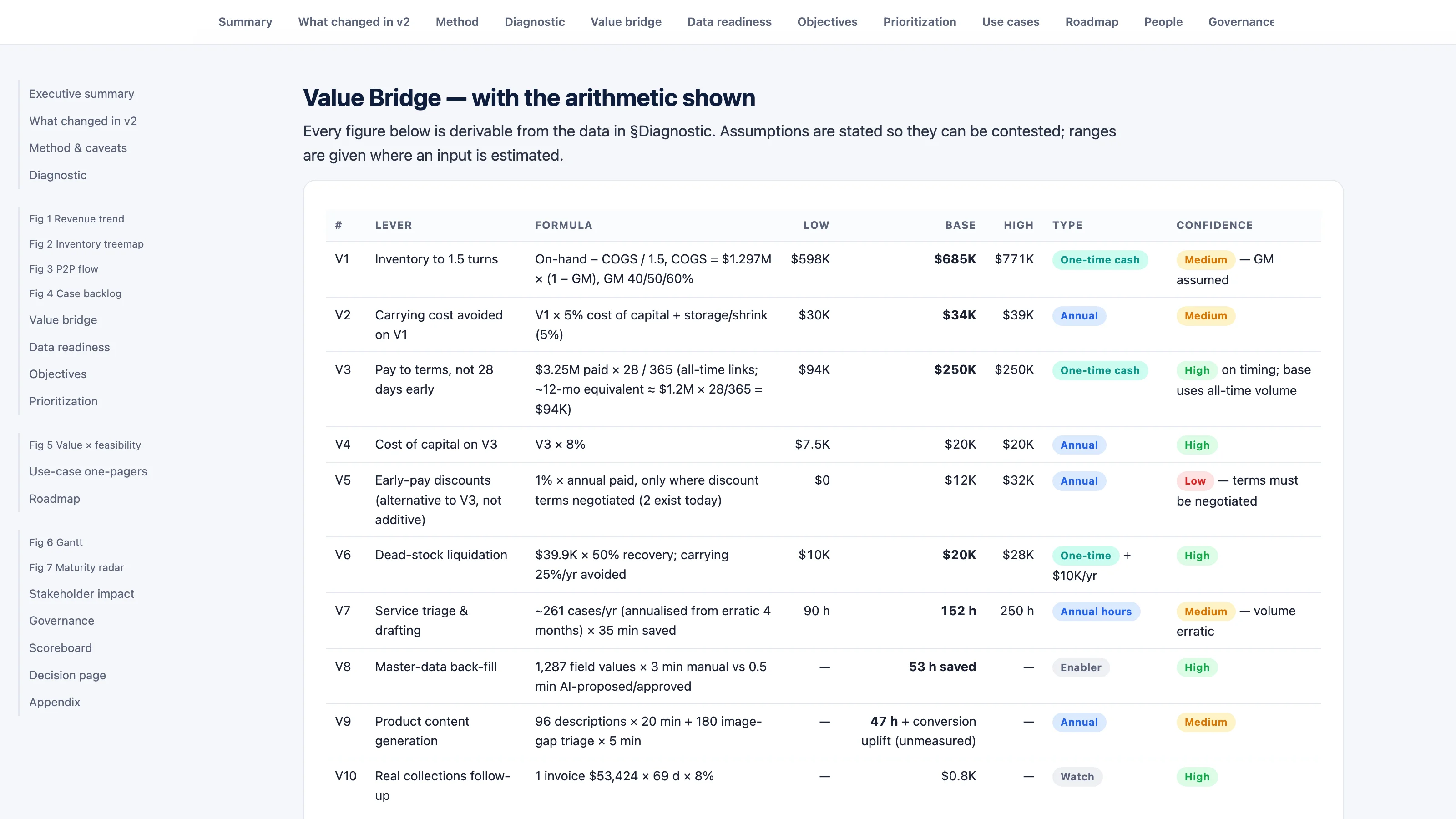
Every lever has a formula, a low, base, and high case, a type, and a confidence rating. Inventory to 1.5 turns is $598,000 to $771,000 of one-time cash, marked medium confidence because cost of sales is estimated from a margin range. Paying to terms is $94,000 to $250,000, with the report noting that the base case uses all-time payment volume and the twelve-month equivalent is the low end. The reviewer had challenged the first version for conflating the float with an annual discount figure, and they're separated now, with early-pay discounts shown as an alternative rather than an addition and rated low confidence because only two vendors have discount terms.
The portfolio view is stated plainly: one-time cash release of $0.7 to $1.0 million, of which the inventory lever is 70 to 80%, so financially this is an inventory program with a finance and service tail. Recurring profit and loss is $55,000 to $80,000 a year plus about 250 hours. Wave one and two cost is model usage and about one and a half full-time equivalents of existing staff time.
Governance as the First Deliverable
The sixth diagnostic finding is the test fixtures themselves, identified by three independent markers: a TEST memo, a creation date after the analysis date, and no source sales order. The report's point is that any forecasting or credit model trained on this ledger would learn from $800,000 of fiction, and that data governance is the first deliverable rather than a preamble. The recommendation is to tag rather than void, and to void only after finance confirms no downstream dependency.
Three Waves
A six-week data-foundation sprint is a hard prerequisite: flag the fixtures, back-fill the four gating master-data fields with AI-proposed and human-approved updates, make case category and origin mandatory, and retire the plaintext credential field on vendor records. Wave one ships three narrow assistants, replenishment recommendations for stocked positions, a payment-timing and anomaly screen for accounts payable, and a service triage copilot. Wave two adds demand forecasting, rebalancing from stores to the distribution center, product content, and conversational analytics for managers. Wave three is churn scoring, next-best-action for sales, supervised finance agents, and vendor intelligence.
Each objective has a data-readiness panel, a set of KPIs with today's value and a target, and a named owner. The operating model is stated as policy: human approval on every write, dry-run diff, read-only analytics by default, privacy mode on for entity analysis, and a monthly audit-trail review with the acceptance rate published. No new AI platform purchase before wave two results.
The Decision Page
The executive team is asked to decide five things: endorse the ten objectives and the wave one scope, approve the sprint as a prerequisite, adopt the operating model, name three business owners, and authorize removal of the thirty test-fixture invoices from production reporting. Review dates are set for each wave exit and for the next strategy refresh.
Wrapping Up
The Business Growth Strategy prompt in the same release reads the same account for commercial strategy. This one reads it for where AI should go first, and it arrives at inventory by a different route.
AI Implementation Strategy is in the paid tier of the library. The full sample report from the test account is online, and I covered the whole September release in a separate post.
The document was reviewed by a second model before it was finished, and it kept a record of what the reviewer changed. I think that every strategy deck should have to survive that.