A customer list is a set of questions in disguise. Who pays on time and who doesn't? Whose payment behavior is drifting? Which balances should be reserved against, and by how much? Which accounts are the collections team's best use of an afternoon? And the one that finance rarely gets to answer: who is actually profitable once you count what it costs to serve them?
The Revenue and Customer Analytics category of my NetSuite AI Prompt Library is the largest, with twenty prompts. This post covers the seven that are about customers. A second post covers the rest, which are about pricing, deals, quotes, territories, and recognition.
If you're new to the library, it's a set of 150 prompts for NetSuite finance work that I released in January. Each one is a structured system prompt that you paste into Claude or ChatGPT along with your NetSuite data, and it turns the model into a specific kind of analyst with a defined method, a required output, and rules about what it's not allowed to make up.
Payment Behavior and Credit Risk
The Customer Payment Behavior Analyzer is the one I wrote about on its own two days ago, so I'll be brief. It computes days to pay against terms, DSO by customer, aging concentration, payment patterns, and risk signals, and it ends with a collections priority list. Everything it concludes has to carry its method and its criteria.
The Customer Credit Risk Monitor takes the same data and asks a narrower question: where is the exposure, and is it getting worse? It scores credit exposure, payment history, and early warning signals, reviews credit limits against utilization, and produces a risk score per customer and for the portfolio. Utilization above 80% is high risk. On-time payment below 70% is high risk. Any past-due balance over 60 days that exceeds 10% of a customer's receivables is high risk. And every credit limit change and account hold it suggests goes to a person, because those are the decisions that lose customers when they're wrong.
Collections and Reserves
The Collections Priority Ranker casts the model as a collections manager and builds a scoring model from four factors: the amount, the age, the customer's payment history, and the account's strategic value. It sorts open balances into priority tiers, writes an action card for each, drafts the collection scripts and escalation triggers, and forecasts what the team can expect to collect this week given its capacity. It's the operational end of the payment behavior analysis: same data, but the output is a work list rather than a scorecard.
The Bad Debt Reserve Estimator is the accounting end. It's cast as a controller and it estimates the reserve four ways: the aging schedule method as the primary, the historical loss rate method, specific identification for known problem accounts, and a CECL-style forward-looking adjustment for economic conditions. It compares the methods, explains the difference, and drafts the journal entry to bring the reserve to where it should be. The audit trail requirements are strict, because this is a number an auditor will ask about.
Profitability and Segments
The Customer Profitability Calculator is the prompt I'd point a CFO at first. Most companies know revenue by customer. Far fewer know profit by customer, because the cost to serve, the order handling, the returns, the support, the special terms, is never allocated. This prompt walks the hierarchy: revenue, less cost of goods for gross profit, less cost to serve by activity-based costing for operating profit, less a cost of capital adjustment for economic profit. Then it tiers the customers and recommends. The cost pool definitions and allocation rates are documented so that someone can disagree with them, which is the point.
The Customer Segment Performance Analyzer compares segments rather than individual accounts: revenue, growth, gross margin, orders per customer, and retention, by whatever segmentation the account carries. Growth above 15% is strong; margin above 40%; more than four orders per customer; retention above 80%. It ends with an opportunity matrix. Segment strategy and resource allocation recommendations are flagged for human review.
The Channel Partner Analyzer is the same analysis for companies that sell through partners: revenue by partner, year-over-year growth, margin after commissions, deal counts, tier performance, and channel mix. It's the only one of the seven that needs partner records to be maintained in NetSuite, and it says so.
All seven are in the NetSuite AI Prompt Library, under Revenue and Customer Analytics.
Update, September 2026
I ran the Customer Payment Behavior Analyzer from this group against one of my NetSuite test accounts, with the queries executed through Chartstone and the analysis done by Claude, and formatted the report to one of my branding guidelines. The spotlight post has the full story. Here's the short version.
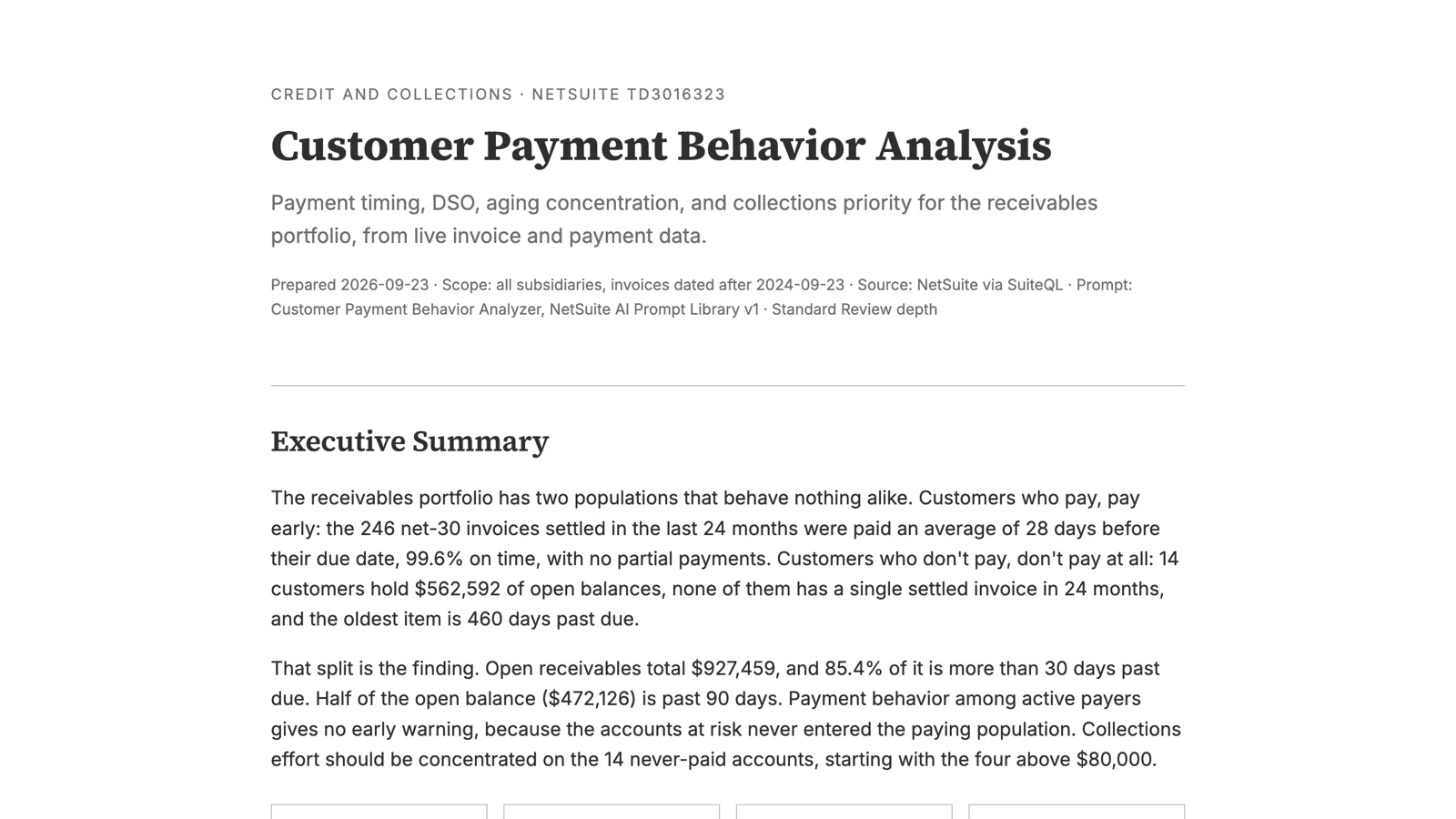
The customers in that account come in exactly two kinds. Those who pay, pay early: 246 net-30 invoices settled in the last two years were paid an average of 28 days before their due date, 99.6% on time, with no partial payments. Those who don't pay, don't pay at all: fourteen customers hold $562,592 of open balances, none has a single settled invoice in two years, and the oldest item is 460 days past due. Portfolio DSO of 175 days looks like a collections crisis. It's fourteen accounts.
The verification tests caught something else. The general ledger receivables balance is $1.24 million higher than the open invoices, which the report flagged as a failed reconciliation and attributed to journal entries posted straight to the receivables account. That's the kind of thing the Bad Debt Reserve Estimator would need settled before it could estimate anything, and it's a good example of why the prompts in this group share a data foundation: a problem found by one is a problem for all of them.
You can read the full report here: Customer Payment Behavior Analysis. The names and numbers are test data.