Every controller gets the same questions, usually from the same two people. The CEO wants to know how much cash there is and whether it's enough. The CFO wants to know why it isn't more. The answers are all in NetSuite, in the receivables, the payables, the inventory, and the bank, and the work is in putting them together in a way that says something.
The Cash Flow and Treasury category of my NetSuite AI Prompt Library is seven prompts that do that work. This post walks through what each one asks for and what it hands back, and then, at the end, what one of them found when I ran it against a real account.
If you're new to the library, it's a set of 150 prompts for NetSuite finance work that I released in January. Each one is a structured system prompt that you paste into Claude or ChatGPT along with your NetSuite data, and it turns the model into a specific kind of analyst with a defined method, a required output, and rules about what it's not allowed to make up.
The Cycle Itself
The Cash Conversion Cycle Optimizer is the one I'd start with, because it frames the other six. The cycle is days sales outstanding plus days of inventory minus days payable outstanding: how long the business finances the gap between paying a supplier and collecting from a customer. The prompt casts the model as a working capital consultant, and it's built around a value framework that's worth quoting: cash released equals daily sales times the DSO reduction, plus daily cost of goods times the DIO reduction, plus daily cost of goods times the DPO extension.
What I like about it is that it doesn't stop at the ratios. It carries tables of levers for each component, with typical effort, impact, and timeline: same-day invoicing is worth three to five days of DSO, SKU rationalization ten to thirty days of DIO, paying on the due date rather than early five to ten days of DPO. The output is a phased plan, quick wins in 30 days, medium-term in 90, strategic beyond that, each with a cash figure, and every target setting and every supplier or customer decision is flagged for a person to make.
The Two Sides of the Ledger
The Accounts Receivable Optimizer and the Accounts Payable Optimizer are mirror images. Each casts the model as a senior manager of its function, runs five queries (an aging summary, a customer or vendor analysis, a DSO or DPO trend, a performance measure, and a list of what's due), and reports against thresholds. For receivables, DSO under 45 days is healthy and over 60 is critical, and more than 15% of the balance past 90 days is a red flag. For payables, DPO between 30 and 45 days is optimal, under 20 is a concern, and discount capture under 50% means money is being left on the table.
The AP prompt has one section I think every accounting team should read regardless of whether they use AI: the discount analysis. A 2% 10 Net 30 term is a 36.7% annualized return for paying twenty days early. The prompt makes the model compute that for every vendor offering terms, and then compare it to the float given up on every vendor that doesn't.
The Executive Summary
The Cash Position Executive Summary is different in kind. It's written for the person who has ninety seconds, and it casts the model as a CFO writing for a board. Its output is fixed in ten parts: a two-sentence headline, a dashboard, a paragraph on the period, a sources-and-uses waterfall, the drivers, the forward look, risks and mitigation, decisions needed, comparison to plan, and takeaways. It runs two queries, cash balances by account and the period's cash flow, and its confidence table is honest about what it can and can't know: the cash position is high confidence because it's an actual balance, and the forward look is medium because it's a forecast.
Currency, Intercompany, and Payments
The Foreign Currency Exposure Analyzer measures transaction and translation exposure by currency, computes FX gain and loss, runs a rate sensitivity, and assesses hedging. Its thresholds are in dollars and percentages: net exposure above $2M is high risk, more than 50% concentrated in one currency is high risk, more than 60% unhedged is high risk. The account I ran the other prompts against is single-currency, so I couldn't exercise this one, and the prompt would have said so itself, because a missing currency table is a blocking data gap under its rules.
The Intercompany Transaction Analyzer is for OneWorld accounts. It matches balances between subsidiaries, finds what doesn't reconcile, reviews eliminations, and looks for netting opportunities. Its healthy state is exact: out of balance by zero dollars, zero unmatched items, settlement in under 30 days.
And the Payment Processing Analyzer looks at how money goes out. Payment methods and their costs, electronic share (above 80% is optimal), duplicate payments (a rate above 0.5% is a concern, and more than five same-day duplicates is a control failure), and check volume. It's the prompt I'd hand to anyone still cutting checks.
All seven are in the NetSuite AI Prompt Library, under Cash Flow and Treasury.
Update, September 2026
I ran the Cash Conversion Cycle Optimizer prompt from this group against one of my NetSuite test accounts, with the queries executed through Chartstone and the analysis done by Claude, and formatted the report to one of my branding guidelines. Here's what it found.
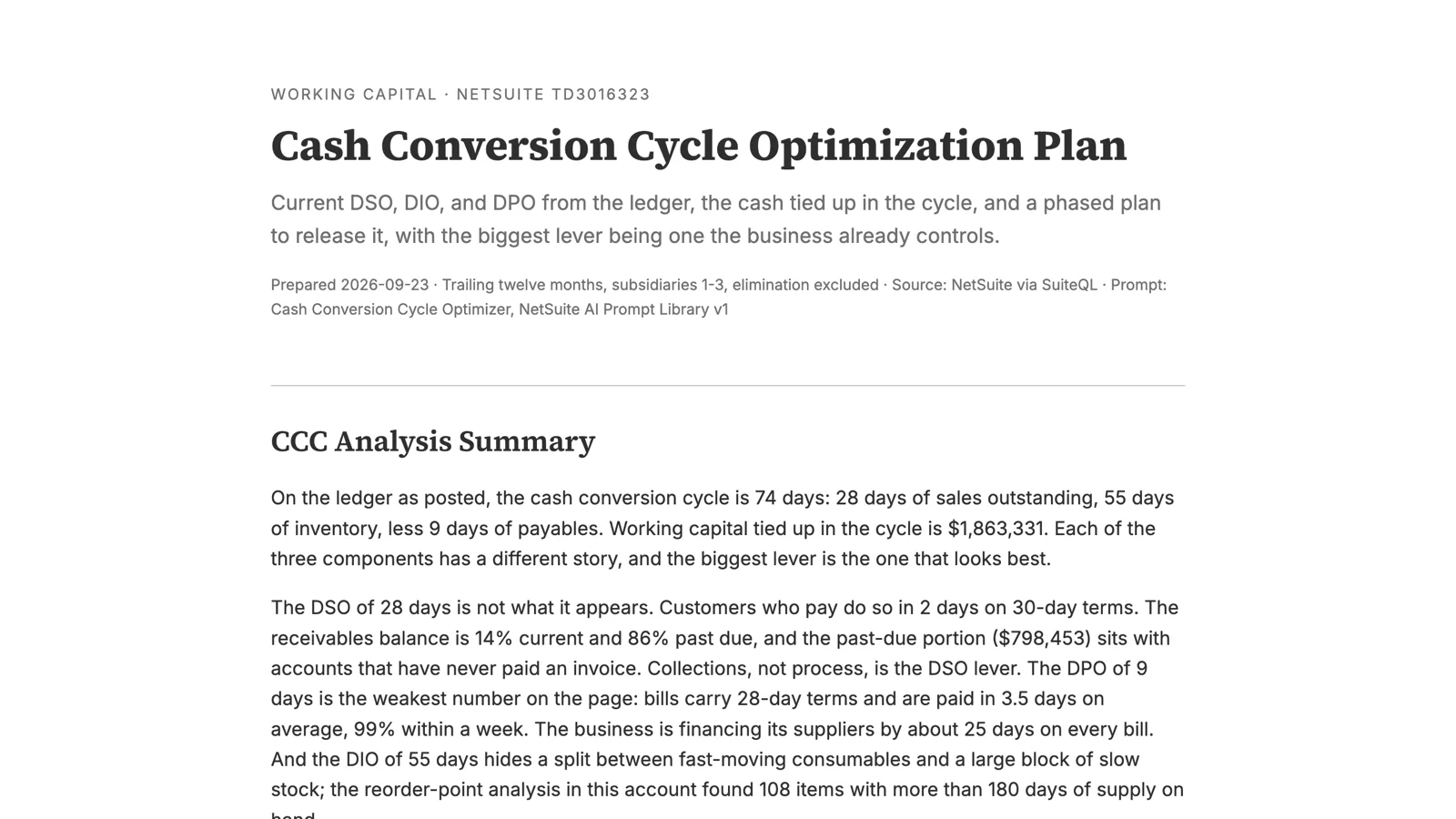
The cycle came out at 74 days on the ledger: 28 days of sales outstanding, 55 days of inventory, and 9 days of payables. That last number is the finding. Vendor bills in that account carry 28-day terms on average and get paid in three and a half days, 99% of them within a week. The business has been financing its suppliers by about three weeks on every bill. Paying on the due date, with no change to any term and no conversation with any vendor, extends DPO by about 20 days and releases roughly $395,000. It's a change to the payment run selection.
The receivables side went the other way. The customers who pay, pay 28 days early, so none of the usual DSO levers, same-day invoicing, reminders, portals, would do anything. What's holding DSO up is $798,000 past due from accounts that have never paid an invoice. That's a collections and credit decision, and the plan says so instead of recommending automation.
And the report did something I'd want any analyst to do. It noticed that 85% of the account's revenue was posted by journal entry rather than by invoices, showed the ratios on both bases, and said the targets should be quoted with their basis until someone explains the journals. The recommendations hold either way, because they act on behavior rather than on ratios.
You can read the full report here: Cash Conversion Cycle Optimization Plan. The names and numbers are test data.