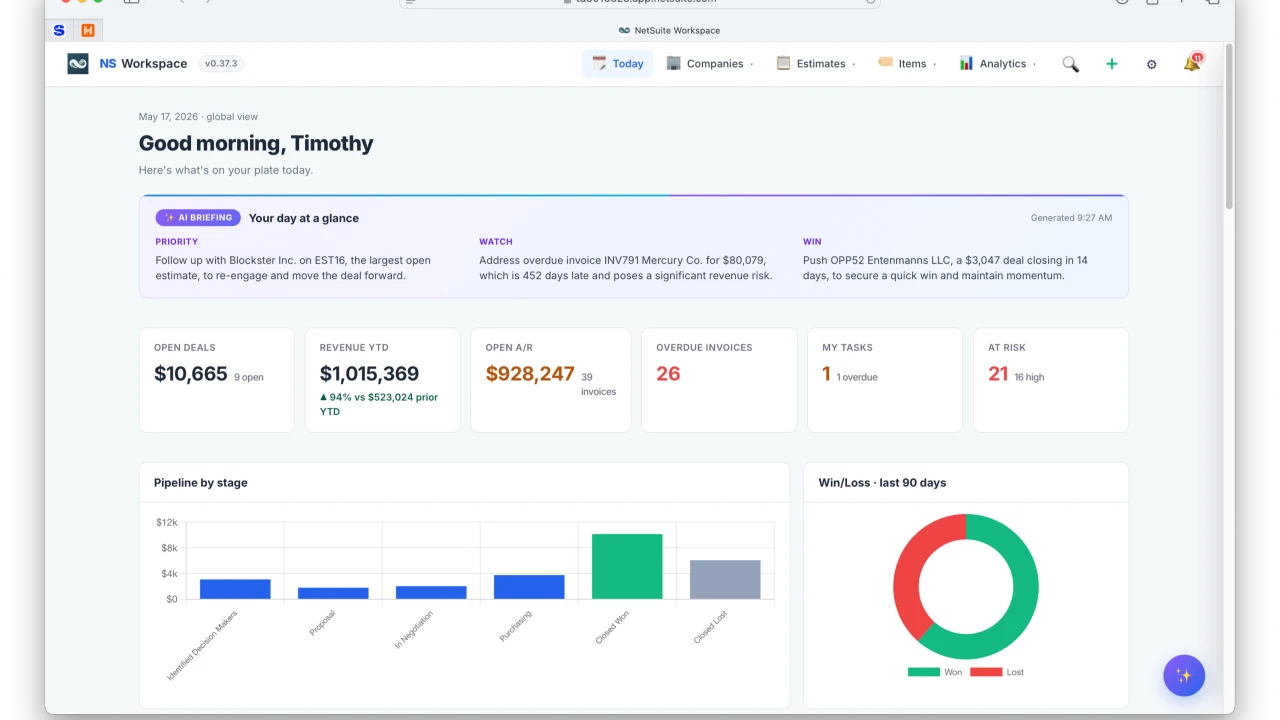
For years I've been developing solutions that sit outside of NetSuite, and that seamlessly integrate with it. Web apps, web portals, mobile and desktop apps. They were purpose-built custom solutions for businesses whose unique needs were better addressed by presenting alternative UIs, form factors, and/or workflows.
I've also been building internal solutions that take liberties with the standard NetSuite UI, providing modern, intuitive, user-friendly user interfaces and user experiences that improve productivity.
And in both cases, because of how NetSuite is modeled, building internal and external solutions was safe. NetSuite's security model was still enforced, as was the core business logic. Those are non-negotiable.
What AI does is make the kind of work I've been doing less expensive and more practical. If you've been following me on LinkedIn, you may have seen my recent work on alternative UIs for NetSuite internal solutions. These projects have been getting quite a bit of attention, because as I've been discussing, with AI they are now within reach of anyone, technical or not, who has interest in building these types of solutions. External apps, while a little more involved and expensive, are now, for the most part, also affordable and practical.
The impact of AI on this type of work is quite obvious.
What isn't obvious, and what I think those of us in the NetSuite community should be discussing, are deeper questions that might make many of us a little uncomfortable. Because they force us to stop and think about not only our own continued relevance (or lack thereof) in the NetSuite ecosystem, but the relevance and future of the platform itself.
I want to put three of those questions on the table. I don't think any of them have settled answers yet, but I have some early thinking, and I'd rather work through them in public than pretend the questions aren't there.
When does NetSuite stop being worth it?
Now that we have powerful and reliable AI-based development tools available, at what scale, and in what industries, does building on a leaner foundation make sense?
My honest answer is: I don't know yet, but I do know that the line is moving. Five years ago, building a custom system of record was a multi-million-dollar undertaking that almost no mid-market company could justify. Today, a small team (or solo developer) with AI assistance can stand up a credible domain model, transactional integrity, and a working UI in a fraction of that time. That doesn't mean businesses should do this, but the option exists in a way that it didn't before. And I know this first hand, because I'm doing it right now.
My current thinking is that NetSuite's value compounds where the full breadth of what it does matters: GL, AR, AP, inventory, warehouse management, order processing, multi-subsidiary, multi-currency, revenue recognition, tax, and the relationships between all of them. If you need most of that, replicating it is still expensive and risky, even with AI help. But if you only need a slice then the calculus is changing. The "we run our whole business on NetSuite" story made sense when the alternative was assembling and integrating ten things. When the alternative is generating something fit-to-purpose in weeks, the comparison gets harder.
I don't think NetSuite is going away for the businesses it fits well. I do think the businesses it fits well will become a more defined set, and the edges will get pressured. Businesses that would rather assemble best-of-breed tools (a focused WMS, a real CRM, a modern HR platform) and tie them together than commit to a single platform trying to do everything. For those businesses, NetSuite's value is in being the financial backbone, not the whole skeleton.
What does the consulting business model look like in five years?
When generation is cheap, what happens to people like me?
Here's what I keep coming back to: the work that's getting cheaper is the work I was doing to deliver solutions. The work that isn't getting cheaper and may actually be getting more valuable is knowing what to deliver in the first place. Understanding a business well enough to model it correctly. Knowing where the gates and exceptions need to be. Recognizing when a client is simply asking for the wrong thing.
That's not a comforting answer for anyone whose value has primarily been in execution speed, and I don't want to pretend otherwise. A lot of NetSuite consulting work is, frankly, configuration and customization that AI agents will do faster, cheaper, and eventually better. The middle of the market is going to get squeezed hard.
What survives, I think, is judgment on one end and genuine product work on the other. The folks who can sit with a client, ask the right questions, and design a system that meets their needs will still be needed. There will probably be fewer of them, and they'll need to operate differently. And the folks building real products on top of or alongside NetSuite - not custom one-offs, but durable tools - have a window that's wider than it's ever been.
Is NetSuite's foundation still a moat?
Or does it get encoded into AI agents too? This is the question that I find to be most genuinely uncertain.
The argument for the moat is that double-entry accounting, subledger integrity, permission models, and audit trails are hard to get right, and NetSuite has spent twenty-plus years getting them right.
The argument against it is that these are now well-understood patterns. Nothing about debits-equal-credits is a secret. An AI agent with a good schema and the right prompts can enforce a lot of what NetSuite enforces.
I think the moat is real, but narrower than it used to be. The real moat is the accumulated decisions about edge cases, the integrations that already exist, the auditors who already trust the output, and the cost of being wrong when you're handling real money. Those things don't vanish because AI got better at writing CRUD apps. But they also don't justify the platform forever, especially for businesses where the edge cases don't apply.
The interesting question isn't whether NetSuite's foundation is defensible in the abstract. It's whether the premium customers pay for it stays justified as alternatives improve. I suspect the platform will need to do more to keep earning that premium. Or, and maybe more interestingly, do less. A focused, AI-native NetSuite offering would be a different kind of response to new entrants like Rillet than piling more features onto the existing product.
Where is NetSuite vulnerable?
This is the question that I think gets the least honest and thorough discussion in the ecosystem, and I suspect it's because most of us make our living inside it. In other words, this is a question that makes us uncomfortable, so we avoid it.
NetSuite's UX is dated, and the recent incremental improvements aren't closing the gap with what users now expect from a modern ERP system. Reporting and analytics are functional but not delightful to work with. CRM is serviceable but loses to focused competitors. The customization model, while powerful, has real ceilings, and the development experience, while much improved, isn't where modern developers want to live. Performance on large datasets remains a recurring complaint.
What should clients do about these gaps now? The pattern I've been advocating and building toward is to let NetSuite be the system of record it's good at being, and to put the experience layer somewhere that it can be truly modern.
The way I see it
A common belief right now is that AI makes the surface of software cheaper, which makes what sits underneath it more valuable. And by extension, that makes established platforms more important, not less.
That argument isn't wrong, exactly. Serious systems of record do become more valuable when the surfaces on top of them are commoditized. But "more important" and "more defensible" aren't the same thing, and I think the ecosystem has a habit of conflating them.
The platform is excellent at what it's excellent at. The pressure is going to come from the edges, from the businesses that don't need the full breadth, from the experience layer where NetSuite has never led, and from AI tooling that steadily erodes the cost of alternatives.
None of that means the platform is in trouble. But it does mean the comfortable framing, that AI just makes what we've always done more valuable, is missing something. The interesting work for the next several years is figuring out where to lean into the platform's strengths, where to build alongside it, and where to be honest that something else might be the better answer.
Some of what I'm building, including Chartstone, and the upcoming Chartstone Studio, is aimed squarely at the experience-layer question. They're letting both technical and non-technical users build solutions with AI that were previously out of reach. That's a bet on a specific reading of where this is going: that the foundation stays valuable, the surfaces get reinvented, and the people who figure out how to bridge the two thoughtfully will be in a good spot.
Wrapping Up
I might be wrong about some of the ideas that I've presented in this article, and I probably am. If you're thinking about these questions too, I'd like to hear your thoughts.