There is a strange disconnect happening in AI right now.
Spend any time following the industry and you'd think that we've already moved past chatbots. The conversation has shifted to agents: AI that works independently, runs on a schedule, responds to events, makes decisions, uses tools, and gets things done while nobody is watching.
I understand the excitement. I've been working on exactly that problem myself.
But something I've seen over the past few months has made me wonder whether the industry is getting a little ahead of the companies it's trying to serve.
A lot of companies are still learning to chat.
And I think that they should be.
What I've Learned From Sonar
When Sonar AI launched, I deliberately built it around an interactive model.
A person asks Sonar to do something inside NetSuite. Sonar works against the company's live data. The person can see what it's doing, review the queries it runs, look at the results, ask follow-up questions, correct it, change direction, and approve anything that carries risk.
It's a conversation.
The AI does a remarkable amount of work, but there's a person sitting there with it.
That design can sound almost old-fashioned when the rest of the AI industry is talking about autonomous agents. But a few days ago the Anchor Group, NetSuite and Ecommerce Specialists announced that Sonar has crossed 100 NetSuite installs, only about two months after launch.
I don't want to read too much into a single number. One hundred installs doesn't prove that I've figured out how companies want to adopt AI.
But I think that it's telling us something.
Companies want to use AI. They want to see what it can do with their own data and their own problems. They want their finance teams, administrators, developers, and operations people experimenting with it.
They're also learning.
That's an important part of this that I think gets lost in the race toward autonomy.
The Conversation Is Part of the Learning
Consider what happens the first time a controller gives an AI access to NetSuite and asks it to analyze Accounts Receivable (AR).
The controller already knows AR. The AI doesn't need to teach them their job.
What they don't know yet is the AI.
So they watch.
They see which records it retrieves. They look at how it interprets the data. They question a conclusion. They ask it to dig into a customer. They notice that it missed something and tell it why. Then they run another prompt.
Eventually, something changes.
The controller starts to develop a sense for what the AI is good at. They learn where it needs more direction. They learn which tasks produce useful results and which don't. They start writing better instructions because they understand how the system responds to them.
And, just as important, they start developing some trust in it.
I think that this period of experimentation is healthy.
We've spent decades building controls around enterprise resource planning (ERP) systems precisely because the things happening inside them matter. They affect financial statements, customers, vendors, inventory, payments, and ultimately the business itself.
Handing autonomous control of those systems to AI is a big jump. A leap of faith, if you will.
Chat gives companies somewhere much safer to start.
Chat Is Also How You Find the Agents
There's another reason that I've become more interested in this progression.
I think that conversational AI is one of the best ways to discover where agents belong.
Imagine that every Monday morning someone asks Sonar to review overdue receivables, identify the accounts that need attention, and prepare a prioritized list for the collections team.
They do it again the next Monday.
And the Monday after that.
At some point, the obvious question is: "Can this just run every Sunday night?"
I've heard versions of that question from Sonar users.
And that's an entirely different way to arrive at an AI agent.
You didn't start with an executive meeting where everyone sat around trying to identify "agentic AI use cases." You started with a person doing real work with AI. They found something useful. They refined it. They repeated it. And eventually the human involvement in that particular part of the process stopped adding much value.
The agent revealed itself.
I think that this is going to be a common path for enterprise AI adoption.
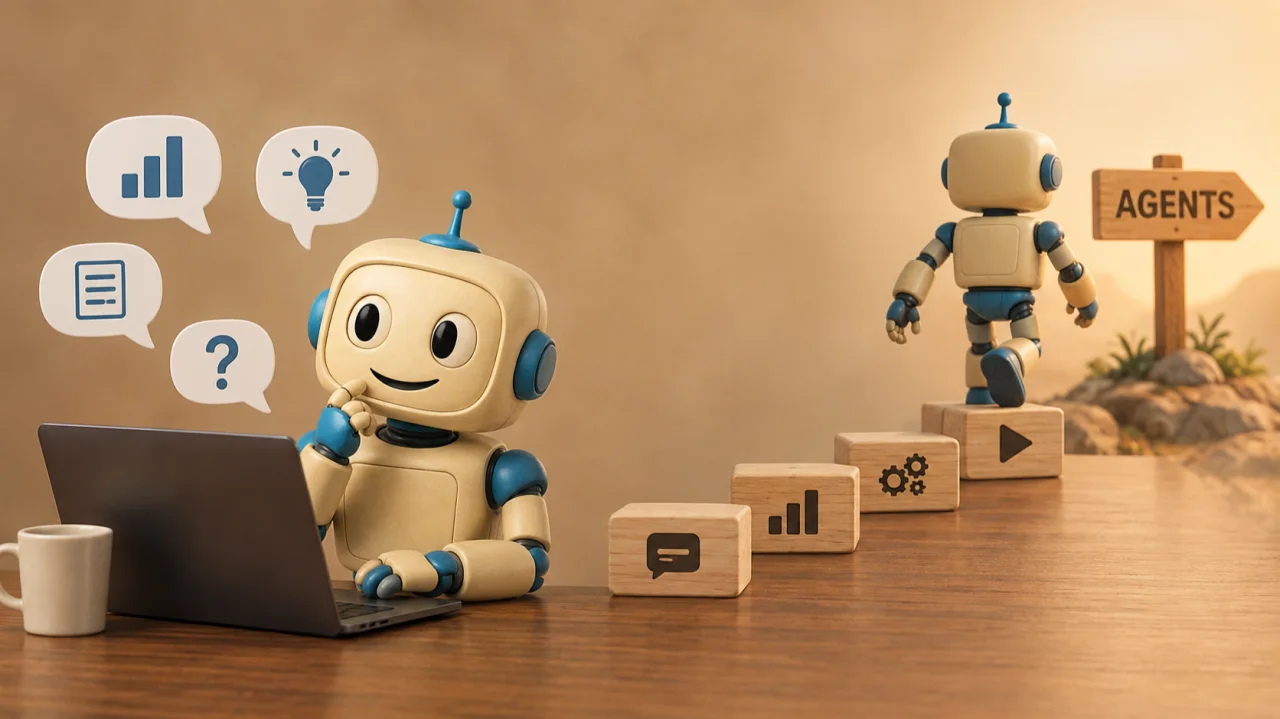
Ask. Analyze. Repeat. Automate. Delegate.
Each step earns the next one.
That's Why I'm Building Helm
This week I announced Helm, an open-source project for running unattended AI agents inside NetSuite.
The timing probably seems ironic given what I'm saying here.
It isn't.
Sonar and Helm are based on the same progression I'm describing.
Sonar is interactive. You ask it to do something, watch its tool calls, review the results, correct it, and approve risky actions. Helm takes work that has already been proven interactively and allows it to run on a schedule or in response to an event.
The connection between the two became clear to me while I was designing Helm.
A Helm agent begins life as a Sonar prompt.
You run that prompt against your own NetSuite account. You watch what it queries and what it does. You correct it. You run it again. Eventually you have something that behaves predictably enough that you're tired of sitting there watching it.
Then you promote it.
Helm moves the controls that the person had been providing into infrastructure: scheduling, permissions, policies, run history, circuit breakers, approval workflows, and limits on what tools the agent can use.
And even then, I don't think that autonomy should be binary.
In the design I've published for Helm, anything with General Ledger (GL) impact or external visibility remains draft-and-approve. The agent can prepare the work, but NetSuite's existing approval workflows determine what happens next. Some lower-risk actions can earn greater autonomy based on the customer's own approval history, within limits chosen by an administrator.
That's a very different model from installing an "AI agent" and deciding on day one how much authority to give it.
The autonomy is earned.
The Human Doesn't Have to Disappear
I think that we've made "human in the loop" sound like a limitation.
It doesn't have to be.
There are plenty of things that I eventually want an AI agent doing without me. I don't need to sit beside an agent at 2:00 AM while it checks for backdated transactions, looks for unusual login activity, or identifies unapplied cash.
There are other things where I want a person involved for a very long time.
The interesting question isn't whether AI agents will replace chat interfaces. I'm fairly certain that agents will take over a tremendous amount of repetitive work.
The question is how companies get there safely.
My suspicion is that the path will be much less dramatic than the AI industry currently makes it sound.
Someone will sit down with an AI and give it a job.
They'll watch it.
They'll correct it.
They'll give it another job.
Eventually they'll notice that they're asking it to do the same thing over and over again.
And one day they'll say:
"Can you just do this without me?"
That's when they're ready for an agent.
Baby steps.