It's the third week of the month, the number is behind, and somebody asks the question: we need more sales this month, what are we not seeing? The usual answer is a scramble. Somebody pulls a pipeline report, somebody else emails the reps, and the answer arrives after the month has closed.
I've been working on a prompt that answers that question from the data that's already in the account, and it'll be in the next release of the Sonar AI Prompt Library. It's called the Sales Growth Opportunity Audit, and it'll be free.
If you're new to this, Sonar AI is an AI agent that runs inside NetSuite. Every prompt in the library is a playbook that I engineered and tested against live NetSuite data, and you run it inside your own account, against your own records.
Seven Places to Look
The prompt runs three investigation tracks, trends and seasonality, pipeline and customers, and inventory and pricing, and it comes back with seven kinds of opportunity. Sold-but-stuck order backlog that can ship this week. Dormant high-value customers worth a personal call. One-time buyers that nobody ever followed up with. Co-purchase patterns that are asking to be bundled. Dead stock tying up working capital. Channel erosion hiding under top-line growth. And the early signals in the numbers that the other six don't cover.
None of those is a new idea. What's different is that all seven come back at once, each with a named work list, and each ranked by how fast the money arrives.
The Rules That Keep It Honest
A sales analysis is easy to get wrong in ways that flatter the reader, so the prompt carries a set of hard rules. A few of them matter more than the rest.
Pace apples to apples. A partial month is never compared to a full month. Month-to-date means day one through today's day number, in both years. And the current month's bucket often includes invoices dated into the future, so if the monthly total and the pacing figure disagree, the chart says why.
Distinguish booked money from speculative money. Open sales-order backlog is booked. Win-backs and campaigns are behavioral. Every move in the playbook carries a confidence rating, and the two are never added together as if they were the same thing.
Scan the work lists for duplicates before recommending bulk action. Same customer, same amount, close dates, in a pending-approval queue: flag the rows, warn against approving in bulk, and say what the match is based on.
And cross-reference. A dormant customer with an order sitting in pending approval isn't two findings. It's one finding, and it's the best kind: the win-back is one approval click.
What It Found
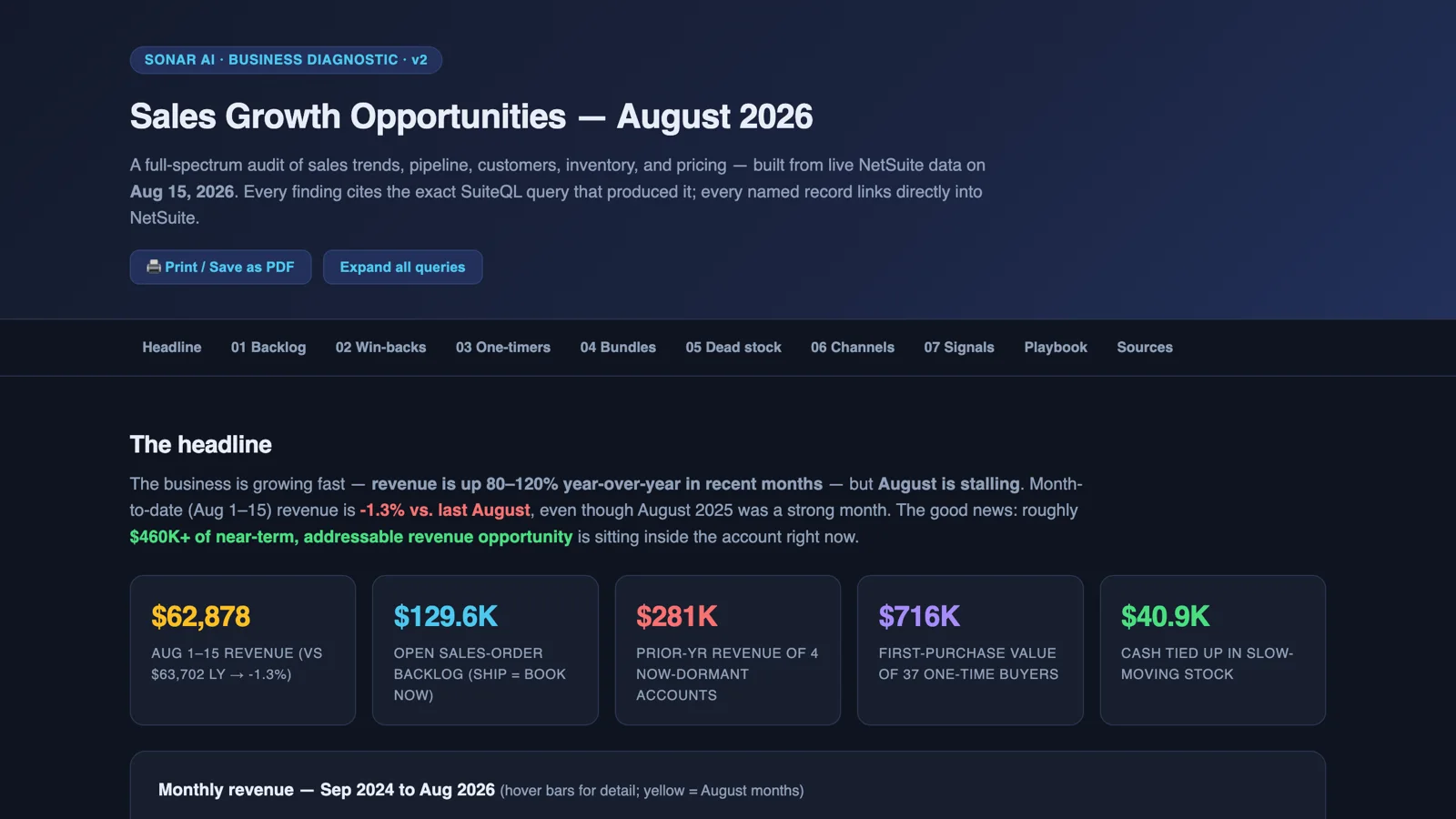
I ran it against one of my NetSuite test accounts on August 15. The business was growing fast, with revenue up 80 to 120 percent year over year in recent months, but August was stalling. Month-to-date revenue was down 1.3 percent against the same fifteen days of the prior August. The report put roughly $460K of near-term, addressable revenue inside the account.
The fastest money was the backlog: $129.6K of sales orders already won but not yet approved, fulfilled, or billed. Forty orders sat in pending fulfillment, the oldest from May. Thirteen sat in pending approval, waiting on a signature. Three were shipped but not invoiced, one click from revenue.
Then the duplicate scan fired. One customer had three pairs of identical-amount orders, entered on August 1 and entered again on August 14. Approving the batch blind could have double-shipped about $11K. The report flagged the six rows, set them aside, and said not to bulk-approve.
The win-back list had four dormant accounts worth $281K of prior-year revenue, and one of them had already come back. Its new order was sitting in pending approval, so the win-back was literally one approval. The one-time buyer list was bigger than I expected: 37 customers, $716K of first-order revenue, never sold to again. The structural finding underneath it was that no second-order motion existed. New large accounts got invoiced once and nobody followed up.
And the top-customer trajectory showed the quiet leak. Growth was acquisition-driven, with three of the top ten brand new, while the former number-one account had shrunk 28 percent. Retention was the problem that the top line was hiding.
The Report
The deliverable is an interactive HTML report, not a slide deck. Every finding has its work list, every named record deep-links into NetSuite, and the queries that produced each number sit in an expandable panel under the finding they support, so anyone can re-run them. It ends with a two-week playbook ranked by speed to cash, and a sources and methodology section that states every assumption, including which claims are general retail knowledge rather than data from the account.
You can see the full report from this run here: Sales Growth Opportunities, August 2026.
Who It's For
Product businesses. Wholesale and distribution, retail, and light manufacturing on NetSuite, where the revenue opportunities live in orders, customers, and stock rather than in a services pipeline.
This prompt will be in the free tier of the Sonar AI Prompt Library in the next release. I'll post here when it's out.