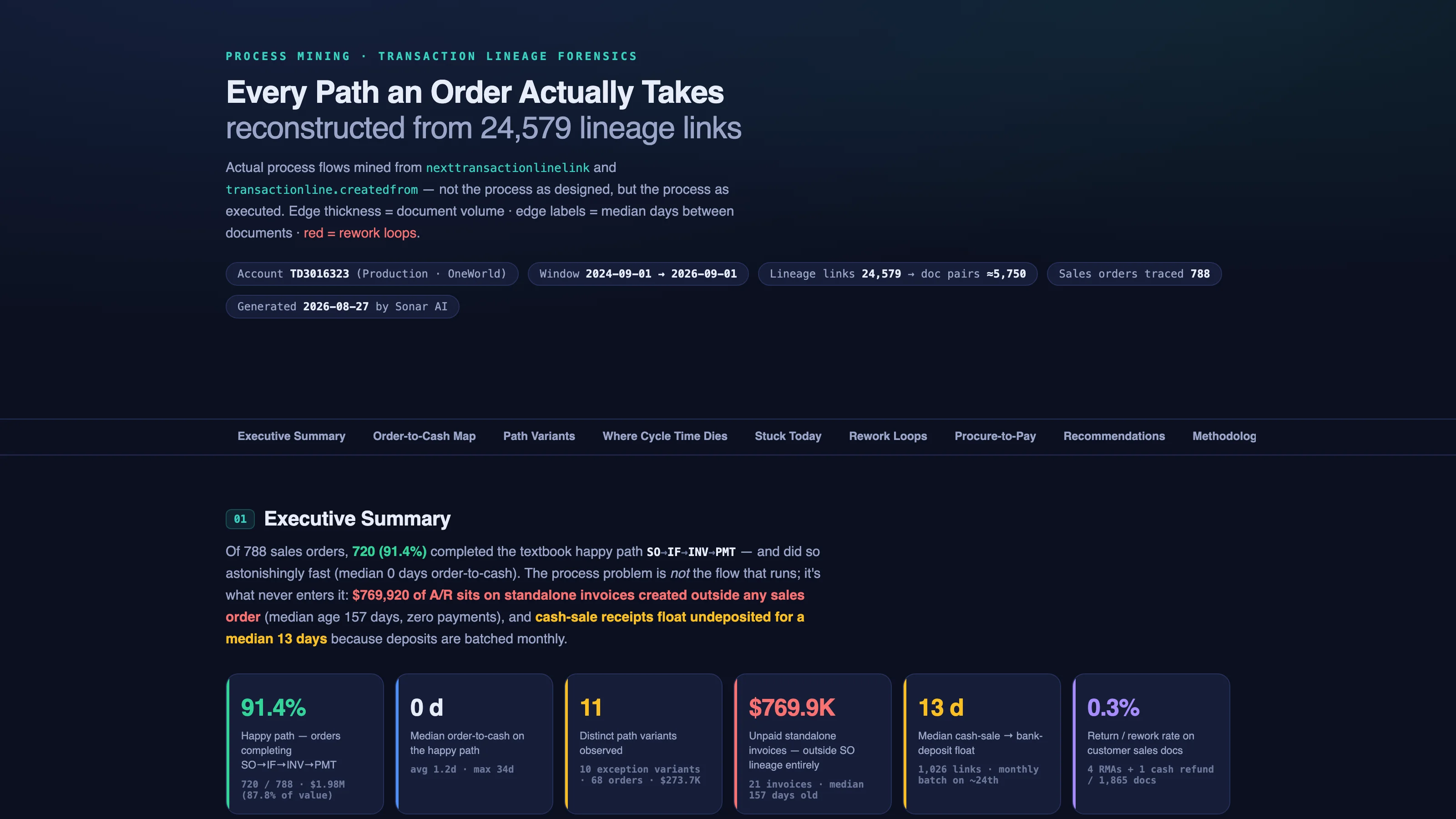
Sometimes you need to see the process rather than read about it. Process Flow Forensics draws the order-to-cash flow in my NetSuite test account as a map: one node per document type, edge thickness scaled to volume, median days between documents on every label, and the rework loops in red. It's the one report in the process-mining series that I'd put on a screen in a meeting before anyone had read a word of it.
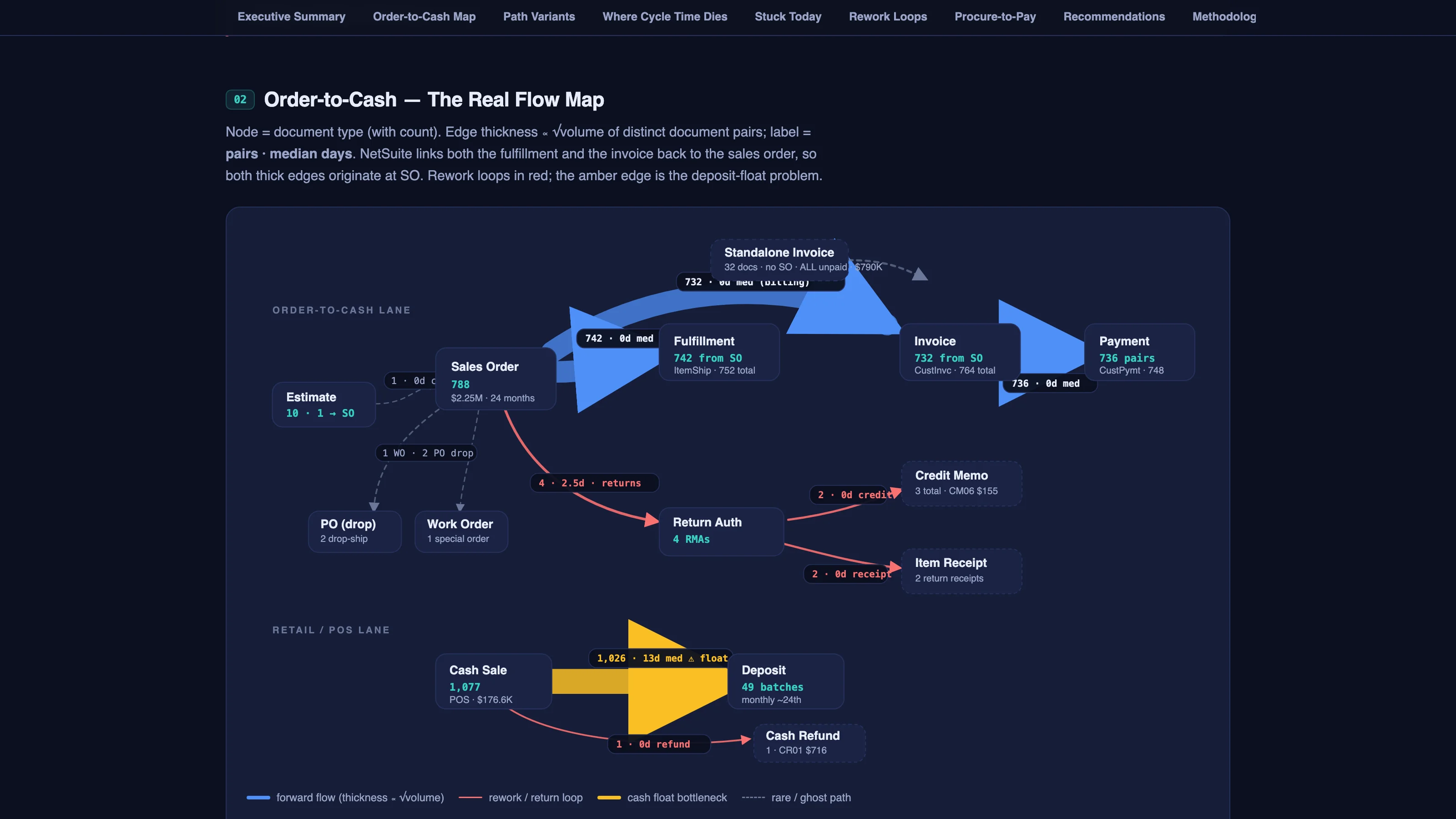
The map on the test account has two lanes. The order-to-cash lane runs sales order to fulfillment to invoice to payment, and the thick blue edges show that 91.4% of orders sailed through it with a median cycle time of zero days. The retail lane runs cash sale to deposit, and its edge is amber, because 1,026 cash sales wait a median of 13 days for a monthly batch deposit. And off to one side, drawn as a ghost path, is a node labeled "Standalone Invoice," 32 documents with no sales order and every one of them unpaid.
It went into the Sonar AI Prompt Library in September alongside the seven process-mining studies. If you're new to this, Sonar AI is an AI agent that runs inside NetSuite. Every prompt in the library is a playbook that I engineered and tested against live NetSuite data, and you run it inside your own account, against your own records. Nothing leaves the account, and nothing is written to it.
Where It Gets the Map From
NetSuite records the lineage between documents in a table called nexttransactionlinelink. On the test account that table holds 24,579 line-level links, which collapse to about 5,750 distinct document pairs once you group by the two documents involved. The prompt cross-validates the pair counts against the created-from pointer on each transaction line, deduplicates the two link types that NetSuite writes for every order-to-invoice pair, and computes the median lag per edge in the database.
Then it assigns every sales order a variant signature from its full downstream document set, two hops deep, and hashes it. Identical signatures are one variant. On the test account, 788 orders produced eleven.
Eleven Paths
One variant covers 720 orders, and the report notes that 91.4% on a single variant is exceptional, since world-class process discipline usually lands between 60% and 80%. Zero split shipments or split invoices were detected across all 788 orders.
The other ten variants hold 68 orders and $273.7K, and the report's point is that they carry outsized value. The average happy-path order is $2.7K. The average stuck order is $4.0K. Seven orders in the invoiced-but-unpaid variant hold $138K, which is 7% of total order value in 0.9% of the order count.
The exception variants are named in a way I found useful: not started, shipped but not billed, billed but unpaid, return loop, bill-only, special order, drop-ship. Each one has a reading beside it. "Shipped, not billed" is labeled as a revenue leakage risk, which is what it is, and the recommendation is a weekly saved search on fulfilled lines where the billed quantity is less than the shipped quantity, to keep that variant at zero.
Where Cycle Time Dies
The stage-by-stage lag table shows the happy path at zero days on every hop, and then it names the four places time goes to die, none of them on the main line. The standalone invoices, $769,920 open with a median age of 157 days and not a dollar collected. The cash-sale deposit float, where receipts from the first of the month wait three weeks for a batch on the 24th. Nineteen fulfillment stragglers over 30 days, including a cluster of eighteen orders from May through August that all took 46 to 49 days, which the report flags as worth a post-mortem. And a big-ticket receivables tail, where the slow payers are the large invoices.
The approval finding is the one I'd act on first. Thirteen August orders worth $55.9K have sat in Pending Approval for a median of 16 days, in an account where everything else happens the same day. The report calls approval the silent killer of August, and its recommendation is an auto-approval threshold for small in-terms orders from existing customers, plus a 48-hour alert on the rest.
What Happened to the Standalone Invoices
I need to be straight about the headline finding, because the account moved after this report ran. Process Flow Forensics was generated on August 27, and it read the 32 standalone invoices as a $770K collections problem: revenue that bypassed the order pipeline and had no fulfillment discipline behind it. That was the right reading of the lineage. Eight days later, the Order-to-Cash study noticed that every one of those invoices carried a memo beginning "TEST," had contiguous internal IDs, and had been created in a single sitting, and it reframed the finding from collections to data quarantine.
Both reports were correct about the structure. Thirty-two invoices with no order, all unpaid, median age 157 days, is exactly what the lineage showed. What the forensics report couldn't see from lineage alone is that the documents were fixtures. I'm leaving the finding in this post as it was reported, because it's a fair example of what each tool does. The map found the block. The later study explained it.
The Mirror Flow
The purchasing side gets its own map, and it runs tighter: 97.6% of purchase orders received, 95.3% billed, bills paid in a median of three days. The same "documents outside the linked flow rot" pattern appears there too. Six aging vendor bills, $231K between them and 139 to 345 days old, are all in the set with no purchase order parent. The report's advice on those is to decide deliberately, dispute, schedule, or pay, because aging silently is the worst option.
How It's Built
Everything in the methodology section is reproducible in the SuiteQL Query Tool. Eight queries, with the variant reconstruction and the stuck-order buckets written out in full, and the medians computed in-database. The assumptions are stated: lags use transaction dates rather than system timestamps, so a document dated retroactively will understate a lag, and two negative-lag journal edges were excluded for that reason. Counts are point-in-time. The document is fully self-contained, with no external scripts or fonts.
Wrapping Up
The seven process-mining studies in the release are audit-grade documents with appendices and hand-checks. This one is the picture. If you want to know whether your order flow has a problem, then run this first and look at the map, and run the study for whichever lane looks wrong.
Process Flow Forensics is in the paid tier of the library. The full sample report from the test account is online, and I covered the whole September release in a separate post.
On the test account, the exceptions were small in count and large in dollars. That's usually how it goes, and it's why a map that scales edges by volume needs a table beside it that scales them by money.