
This article was originally published on LinkedIn.
Late last year, a company running on NetSuite came to me with a problem that I think a lot of companies are also dealing with. They had vendor rebate agreements with dozens of suppliers, and they were managing the entire process with spreadsheets and email.
Agreements were stored as a mix of PDF and Excel files, in multiple inbox folders, and in folders on shared drives. Calculations were being done in multiple Excel files. And every quarter, someone would scramble to figure out where things stood, and at a point where it was usually too late to do anything about it.
My client knew they were leaving money on the table, but they didn't know how much.
Over the course of a few AI consulting sessions, we mapped out their rebate management process from end to end, and started identifying specific, practical ways that AI could help. Some of the applications that we came up with were things that they could start using right away, with the AI tools that were already available to them, including Claude and the NetSuite AI Connector.
They're three months in now, and the results have been better than either of us expected. I'll come back to their story later in this post.
But first, I want to walk through what vendor rebate management involves, where companies tend to struggle with it, and how AI can help at each stage.
I'll include the actual prompts that I've developed for this work, because I think that seeing the prompts is where things get concrete. It's where the abstract idea of "using AI for rebates" becomes something you can sit down and try.
And to give you a sense of what's possible, I want to start by showing you something.
Example Output: Vendor Rebate Optimization Report
The report below (and available here in its entirety) is an example of what AI can produce when you give it the right data and the right instructions. It's a vendor rebate optimization analysis for a fictional electronics wholesaler, complete with a portfolio overview of 15 vendors, tier progress tracking, financial impact projections with sensitivity analysis, specific purchasing recommendations for each vendor, and a quarterly monitoring plan with decision checkpoints.
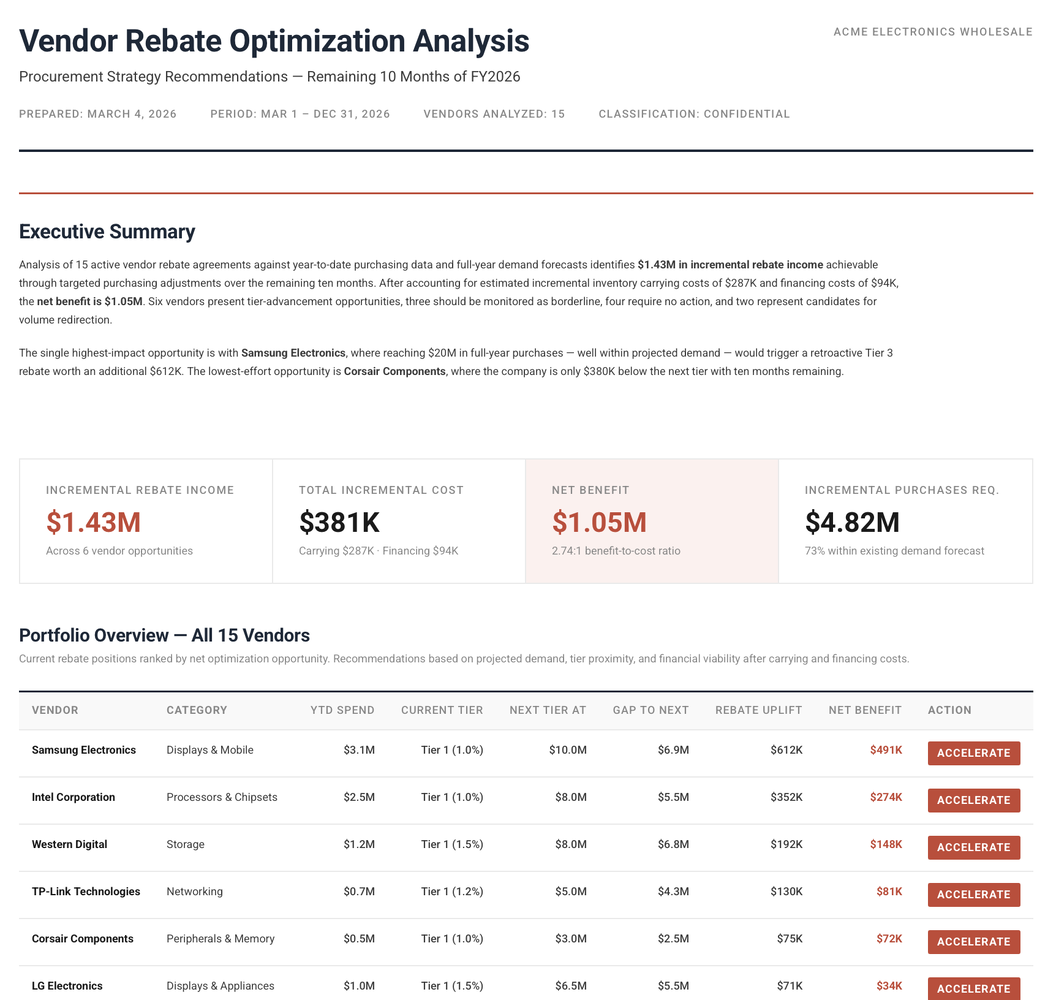
I generated this from a single prompt. One prompt, one pass. The data is fictional, but the structure and analysis are representative of what I've been building with clients. I'll share the prompt later in this post.
Please take a minute to look at it. Then consider what it would take to produce something like that manually. The data gathering, the cross-vendor analysis, the financial modeling, the formatting. That gap between what AI can produce in minutes and what would take a team days to assemble is what this post is about.
If You're New to Vendor Rebates
If you already know how vendor rebates work, feel free to skip ahead. For everyone else, here's a quick overview.
Vendor rebates are retrospective incentives that suppliers offer to buyers based on purchasing performance over a defined period. Unlike early payment discounts - which are captured at the invoice level - rebates are earned over time based on volume, product mix, growth targets, or other criteria. A typical agreement might read something like: "Purchase $2M or more of Category A products within the fiscal year, and receive a 3% rebate on all qualifying spend."
The financial stakes are high. For companies with large procurement operations, rebate income can represent millions of dollars annually. And the lifecycle of managing those rebates is more involved than most people expect.
It starts with negotiation - agreeing on the rebate terms with the vendor. Then comes transaction tracking, where you identify which purchases qualify toward which agreements. Finance needs to accrue the expected rebate income during the earning period for accurate reporting. At the end of the period, you calculate what's owed and file a claim, or the vendor issues a credit. The two sides reconcile any differences. The rebate gets settled. And then you review performance to inform the next round of negotiations.
Every one of those stages introduces opportunities for error and delay. And in my experience working with clients on this, most of them do go wrong in some way.
Where Things Go Wrong
The problems with vendor rebate management tend to compound. One issue in agreement tracking creates downstream errors in calculation, accrual, reconciliation, and settlement. Here's where I see companies struggle the most.
Fragmented agreement data. Rebate agreements arrive in every format you can imagine: multi-page PDFs, email confirmations, amendment letters, verbal agreements that eventually get documented in a spreadsheet. There's rarely a single, structured source of truth for all active terms. When a new analyst takes over, they may not even know all the agreements that exist. A mid-period amendment might not make it into the tracking system. And when disputes come up with vendors, finding the definitive version of an agreement can take hours.
Complex and varied structures. No two agreements look the same. Some vendors offer a flat percentage on all purchases. Others use tiered structures where the rate increases as volume thresholds are crossed, or combine volume-based and growth-based components with different rates for different product categories and retroactive adjustments when higher tiers are reached. Each agreement needs its own calculation logic, and the permutations multiply as the vendor base grows.
Transaction matching. Not every purchase from a vendor qualifies toward a rebate. Agreements may exclude certain product lines or limit qualifying purchases to specific locations and channels. Returns and credits may reduce the qualifying base. Filtering the transaction stream against these criteria - especially when the criteria are buried in contract language rather than structured data - is one of the most error-prone parts of the process. A single misclassified product category can materially affect the calculation.
Inaccurate accruals. Accounting standards require that expected rebate income be accrued during the earning period, but the final amount often isn't known until everything is tallied. For tiered rebates, the accrual gets especially tricky: if you're near a threshold boundary, then the difference between hitting and missing the next tier can represent a big swing in income. Many companies default to simple linear accrual methods that don't account for seasonality or purchasing variability. The result is a material adjustment at period-end, and that creates P&L volatility that draws auditor attention.
Missed thresholds. This might be the most expensive problem on this list. If procurement isn't tracking progress toward rebate thresholds in real time, then there's no opportunity to adjust purchasing behavior to capture a higher tier. A company might end the year at $1.9M in qualifying purchases against a $2M threshold - never realizing that a modest acceleration of planned purchases would have earned a rebate worth tens of thousands of dollars. And sometimes agreements simply expire without a claim being filed, especially in organizations where rebate management responsibility is distributed or unclear.
Painful reconciliation. When a company submits a claim or receives a vendor credit statement, the two sides frequently disagree on the amount. Different transaction dates, excluded returns, different interpretations of qualifying criteria, mismatched product codes - all common. Resolving these discrepancies requires line-by-line comparison of transaction data, and it can delay settlement by weeks or months.
ERP limitations. Many Enterprise Resource Planning (ERP) systems handle transactional purchasing data well but lack the agreement management, threshold tracking, calculation, and reporting capabilities that rebate management requires. Companies fill the gap with spreadsheets, and that brings all the familiar risks: version control problems, formula errors, no audit trails, and key-person dependency.
Compliance exposure. Rebate income recognition must comply with applicable accounting standards. When the tracking and calculation process is informal - scattered across spreadsheets and email - then it's difficult to demonstrate to auditors that rebate income is recognized in the correct period and at the correct amount. This creates compliance risk and often leads to conservative recognition that delays the financial benefit.
How AI Can Help
When working with my client on vendor rebate management, we initially identified seven areas that we could apply AI to. Some of them were straightforward automation - taking tedious manual work and handling it faster and more consistently. Others were where AI really started to deliver ROI, including surfacing patterns and recommendations that would be impractical to develop by hand.
For each area below, I'll walk through what AI can do and share basic versions of the prompts we used. While these are working prompts, they're designed to be adapted to your specific data and agreement structures.
A quick note about the prompts that I'm sharing: Notice that when it comes to providing the data that the AI will need, I used placeholders. I did that intentionally, because it means that the prompts should be usable on multiple ERP systems. If you are a running on NetSuite, and have the NetSuite AI Connector available, simply mention that fact to the AI.
Intelligent Agreement Ingestion and Structuring
The first thing I worked on with my client was the agreement mess. They had rebate terms scattered across dozens of documents in different formats - formal contracts, email threads, scanned PDFs, notes from phone calls that someone had typed into a spreadsheet after the fact. Before you can do anything intelligent with rebate data, you need it in a structured, consistent format.
AI is well-suited for this. Natural Language Processing (NLP) models can read rebate agreements - whether they're PDFs, scanned documents, or email text - and extract the data elements that matter: vendor name, effective dates, qualifying products, volume thresholds, rebate rates, exclusions, claim deadlines, and settlement terms. The extracted data gets presented for human validation and then loaded into whatever system you're using to track rebates.
But it goes beyond simple extraction. AI can compare newly ingested terms against prior agreements with the same vendor to flag changes and spot inconsistencies between what was negotiated and what ended up in the contract. It can also catch unusual or unfavorable clauses that might otherwise go unnoticed.
PROMPT: AGREEMENT INGESTION
You are a rebate agreement analyst. I will provide you with the text of a
vendor rebate agreement. Extract the following fields into a structured JSON
format: vendor name, agreement effective date, agreement end date, qualifying
product categories, excluded products, volume thresholds (as an array with tier
name, minimum qualifying spend, and rebate percentage for each tier), whether
the rebate is retroactive to the first dollar when a tier is reached, claim
submission deadline, and settlement method. If any field is ambiguous or
missing from the agreement, flag it explicitly rather than guessing. After
extraction, list any terms that differ from the following prior agreement
terms: [insert prior terms]. Here is the agreement text: [paste agreement].
Automated Transaction Matching and Qualification
Determining which purchases qualify toward which rebate agreement sounds simple enough, but it's one of those tasks that gets complicated fast. Each agreement has its own rules - specific products, specific locations, specific channels, specific time periods. Applying those rules accurately across thousands of transactions is where errors creep in, and where a lot of rebate leakage starts.
AI can learn the qualification rules for each agreement and apply them at scale across the full transaction stream. Machine learning models can even handle the ambiguous cases that trip up manual processes - a product that might fall into one of two categories, a transaction that straddles a period boundary, a return that may or may not reduce qualifying volume, a credit memo that doesn't map cleanly to a single order - by learning from how similar cases were resolved in the past.
What I really like about this approach is that the system can flag edge cases for human review instead of making assumptions. Over time, as humans resolve those edge cases, the model gets better at handling similar situations on its own. It's a feedback loop that improves accuracy with every cycle.
PROMPT: TRANSACTION QUALIFICATION
You are a transaction qualification engine for vendor rebate management. Given
the following rebate agreement terms and a list of purchase transactions,
classify each transaction as "qualifying," "non-qualifying," or "review
needed." For each classification, provide the reason. Agreement terms: Vendor
is Acme Supply Co. Qualifying period is January 1 through December 31, 2026.
Qualifying products are all SKUs in the "Industrial Fasteners" category except
SKUs tagged as "specialty" or "custom." Only purchases shipped to US warehouses
qualify. Returns reduce qualifying volume. Here are the transactions: [insert
transaction data as CSV or JSON]. For any transaction you classify as "review
needed," explain what additional information would resolve the ambiguity.
Predictive Accrual Forecasting
If you've worked in finance, you know that rebate accruals are one of those areas where "close enough" can mean a huge, considerable adjustment at period-end. Simple linear projections, such as taking year-to-date spend and extrapolating forward in a straight line, miss the mark, because purchasing patterns are never linear. They're seasonal and "lumpy," because they're influenced by factors that simple projections can't account for.
Machine learning models can produce more accurate accrual forecasts by incorporating historical purchasing patterns, seasonality, current pipeline or forecast data, and real-time progress toward thresholds. For tiered rebates, the model can estimate the probability of reaching each tier and compute an expected value that reflects that uncertainty. Instead of a single-point estimate that's probably wrong, you get a range with probabilities attached.
And this matters for more than just accounting accuracy. A good forecast gives you early warning when purchasing trends suggest that a previously expected threshold might not be reached, which gives procurement time to respond before the opportunity is gone.
PROMPT: ACCRUAL FORECASTING
You are a financial forecasting analyst specializing in vendor rebate accruals.
Based on the data below, provide a rebate accrual estimate for the current
period and explain your reasoning. The rebate agreement with Delta Distributors
has the following tiers: Tier 1 is 1.5% on spend from $0 to $999,999; Tier 2 is
2.5% on all spend if total reaches $1,000,000 to $1,999,999 (retroactive to
first dollar); Tier 3 is 3.5% on all spend if total reaches $2,000,000 or more
(retroactive to first dollar). The agreement period is January 1 through
December 31, 2026. Year-to-date qualifying spend through August 31 is
$1,340,000. Monthly qualifying spend for the past 24 months is: [insert monthly
data]. Provide: (a) projected full-year qualifying spend with a confidence
interval, (b) the probability of reaching each tier, (c) the recommended
accrual amount as of August 31, and (d) any risks or opportunities you
identify.
Proactive Threshold Monitoring and Purchasing Optimization
This is where AI is delivering the most direct financial impact to my client, and it's the area that connects to the example report I showed earlier.
An AI-powered monitoring system can continuously track progress toward every active rebate threshold, and generate alerts when action could influence the outcome.
But tracking is only part of it. The system can also determine whether accelerating purchases makes economic sense, by weighing the incremental rebate income against carrying costs and cash flow impact, and factoring in whether you really need the inventory that soon. It's one thing to know that you're $100K short of a threshold. It's another thing entirely to know whether closing that gap is worth the cost.
At a portfolio level, AI can look across multiple vendor agreements simultaneously and identify situations where shifting volume from one vendor to another would capture a higher-tier rebate without increasing total spend. That cross-vendor optimization is difficult or even impossible to do manually, especially when you're managing dozens of agreements.
The vendor rebate optimization report I showed earlier is an example of this kind of analysis. Here's the prompt that generated it:
PROMPT: PURCHASING OPTIMIZATION
You are a procurement optimization advisor. Analyze the following vendor rebate
positions and recommend actions to maximize total rebate income for the
remaining 4 months of the fiscal year. For each vendor, I'll provide the
agreement terms, year-to-date qualifying spend, and projected remaining demand.
Our cost of capital is 8% annually, and our average inventory carrying cost is
18% of inventory value per year. Only recommend accelerating purchases if the
net financial benefit (rebate gain minus incremental carrying and financing
costs) is positive. Here are the vendor positions: [insert data for each vendor
including agreement terms, YTD spend, distance to next tier, and projected Q4
demand]. For each vendor, provide: (a) current tier and distance to next tier,
(b) whether reaching the next tier is achievable and financially worthwhile,
(c) specific recommended action with dollar amounts, and (d) the net financial
impact of the recommendation.
From that single prompt, with the right data being provided, the AI produced a full report covering 15 vendor agreements, complete with a portfolio overview table, tier progress visualizations, detailed analysis of the top opportunities, a sensitivity analysis under different demand scenarios, and a quarterly monitoring plan with specific decision checkpoints. It identified $1.43M in incremental rebate income and accounted for $381K in carrying and financing costs. It also recommended specific actions for each vendor, including two where it recommended against acceleration because from a financial standpoint, it just didn't make sense.
That kind of analysis was taking my client's procurement team days to assemble manually, and even when they were finished, they weren't very confident with what they'd pulled together. But now, because the analysis is generated from a prompt, using data sourced directly from NetSuite, it can be refreshed on demand.
Automated Reconciliation and Discrepancy Resolution
My client told me horror stories about their previous manual process for reconciling rebates. Their numbers would say one thing, while their vendor's numbers would say something else entirely. They described how in some cases it would take days or even weeks, going line by line through transaction data, to try to find where the gaps were.
AI can automate the matching of internal transaction records against vendor statements, quickly identifying transactions that appear in one dataset but are missing from the other. It can also recognize patterns in the discrepancies themselves. Maybe there's a systematic two-day difference in how the vendor dates transactions, or a specific product line is consistently excluded from their calculation. Or maybe returns are being treated differently. AI can surface those types of patterns, instead of requiring someone to identify them manually.
And for recurring discrepancy patterns with specific vendors, the system can learn to pre-adjust calculations, and flag likely disputes, before a claim is submitted. That alone can cut weeks off the reconciliation cycle.
PROMPT: RECONCILIATION
You are a rebate reconciliation analyst. I have two datasets for the Q3 2026
rebate with Pinnacle Parts Co: our internal calculation showing $47,230 in
rebate earned, and the vendor's credit memo for $43,875 — a discrepancy of
$3,355. Below are both transaction-level datasets. Match transactions between
the two datasets using PO number, invoice number, and amount. For unmatched
transactions, attempt fuzzy matching on date (within 5 days) and amount (within
2%). Produce a reconciliation report that includes: (a) the total number and
dollar value of matched transactions, (b) a list of transactions in our data
but not the vendor's, (c) a list of transactions in the vendor's data but not
ours, (d) transactions that match on ID but differ on amount, and (e) any
patterns you observe in the discrepancies (date offsets, product category
concentrations, systematic exclusions). Here is our data: [insert internal
data]. Here is the vendor's data: [insert vendor data].
Vendor Performance Analysis and Negotiation Intelligence
This is one of those capabilities that most companies don't have, and probably don't realize they're missing. It's a portfolio-level view of rebate performance across all vendors and agreements. It's the kind of analysis that can answer questions like: Which agreements consistently underperform relative to their potential? Which vendors are slow to settle claims or create friction in the reconciliation process? Where has our purchasing pattern shifted in ways that make an existing rebate structure a poor fit? What do our best-performing agreements have in common?
I think every procurement team should be asking these questions. But I also think that most teams aren't, because developing the analysis by hand would take considerable time and effort.
But AI can produce this view in a matter of minutes, and the output can then be used to drive rebate renegotiation strategies. My client was thrilled when they were able to use a solid, data-backed analysis showing that their rebate structure didn't match their purchasing pattern, along with a specific proposal for how to restructure it.
PROMPT: VENDOR PERFORMANCE ANALYSIS
You are a strategic procurement analyst. I'm preparing for annual rebate
renegotiations and need a portfolio-level analysis. For each of the following
15 vendor rebate agreements, I'll provide: the agreement terms, actual
qualifying spend for the past 3 years, rebate earned vs. rebate potential
(maximum possible) for each year, the average number of days to settle each
claim, and the number and dollar value of discrepancies per period. Analyze
this portfolio and provide: (a) a ranking of agreements by "rebate efficiency"
(actual earned as a percentage of maximum possible), (b) identification of
agreements where our purchasing pattern has shifted enough that the tier
structure no longer fits well, (c) vendors with the most friction in the claim
and settlement process, (d) specific renegotiation recommendations for the
bottom 5 agreements by efficiency — including suggested structural changes to
the rebate terms, and (e) an estimate of the incremental annual rebate income
achievable if your recommendations are implemented. Here is the data: [insert
portfolio data].
Compliance Documentation and Audit Readiness
This area isn't as exciting as threshold optimization or negotiation intelligence. But my client is thrilled that we've been able to apply AI to it, because they now feel that they're fully prepared to answer an auditor's questions about their rebate accruals.
They can now provide clear evidence that their rebate income is being recognized in the correct periods and at the correct amounts, and that the accrual methodologies being used are both reasonable and being applied consistently.
AI can generate a documentation trail automatically: period-end calculation summaries showing the methodology and data sources for each rebate accrual, variance analyses comparing accruals to actuals with explanations for material differences, agreement-level memos documenting the accounting treatment rationale, and threshold-progress reports for each active agreement.
For organizations subject to ASC 606 or IFRS 15, AI can also help to determine if specific rebate arrangements should be treated as reductions in the purchase price, or as separate transactions, and make sure that the recognition timing aligns with the standard's requirements.
PROMPT: AUDIT DOCUMENTATION
You are an accounting compliance specialist. I need to prepare audit
documentation for our vendor rebate accruals for fiscal year 2026. For each of
the following rebate agreements, generate an audit memo that includes: (a) a
summary of the agreement terms, (b) the accrual methodology used and why it's
appropriate for this agreement structure, (c) quarterly accrual amounts
recorded during the year, (d) the actual rebate earned and settled, (e) the
variance between accrual and actual with an explanation, (f) the accounting
treatment applied (purchase price reduction vs. other income) with a brief
rationale referencing the applicable standard, and (g) any judgment areas or
estimates involved. Flag any agreements where the variance between accrual and
actual exceeded 10%, as these will require additional auditor attention. Here
are the agreements and their year-end results: [insert data].
Putting It Into Practice
Adopting AI for vendor rebate management doesn't require a massive, all-at-once implementation. I think the most pragmatic approach is to start where your pain is worst, and then build from there.
My client started with the basics: digitizing their agreements and getting everything into a structured format. Before AI can add value, rebate agreements and transaction data need to be accessible in a consistent, structured way. For them, that meant using the AI-assisted ingestion approach to convert their existing contracts into structured records and establishing a central repository for everything.
From there, we automated the transaction matching, calculation, accrual, and claim preparation. This is where the most common sources of error had been living, and eliminating them freed up their team to focus on higher-value work, instead of spending time checking spreadsheet formulas.
The next layer was forecasting, threshold monitoring, purchasing optimization, and the checkpoint cadence that brings it all together. This is where the financial return started to accelerate, because it shifted rebate management from a reactive, end-of-period scramble into an ongoing, proactive process.
My client recently told me that their vendor rebates are much more manageable than they've ever been. They like knowing where things stand at any point in time, instead of discovering their position when it's too late to do anything about it.
They're on track to earn rebates that they're confident they would have missed using their old manual process. And the regular checkpoints have been one of the biggest wins. Instead of scrambling to figure out which thresholds were hit and which were missed, they're reviewing progress on a regular schedule and making purchasing adjustments along the way.
The longer-term goal is portfolio-level decision-making: using the analysis that AI provides to help with vendor negotiations and purchasing strategy across their entire supplier base.
If you think about all of this as a maturity curve, it looks something like this: first you digitize and centralize, then you automate, then you add prediction and optimization, and then you're operating at a strategic level where rebate management feeds directly into procurement strategy. Each stage builds on the one before it, and each one delivers value on its own.
Getting Started
For my client, the rebate dollars were already there. But they were buried in the terms of the agreements that they had negotiated, and the process for tracking and claiming those rebates was burdensome.
If any of the challenges I've described sound familiar, then I encourage you to pick the prompt that I've shared that addresses the area that's causing you the most pain. Adapt it to your own data, use it, and see what happens. You don't need to build the entire system at once to start seeing the benefits.
My client started with one problem and one prompt. And now they're running a process that used to run them.